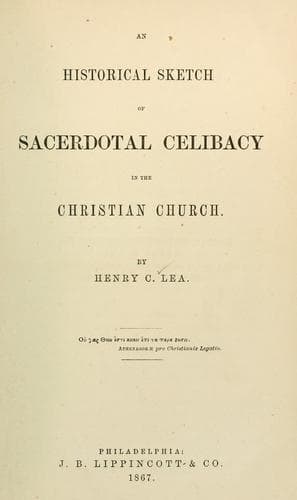
An Historical Sketch of Sacerdotal Celibacy in the Christian ChurchLea, Henry Charles
History
An Historical Sketch of Sacerdotal Celibacy in the Christian Church
Lea, Henry Charles
Catholic Church -- Clergy; Celibacy -- Catholic Church; Church history
Nor was it only in stimulating this general laxity of principle that
the influence of the church was disastrous. The personal evil wrought
by a dissolute priesthood was a wide-spreading contagion. The abuse
of the awful authority given by the altar and the confessional,
was a subject of sorrowful and indignant denunciation in too many
synods for a reasonable doubt to be entertained of its frequency or
of the corruption which it spread through innumerable parishes and
nunneries.[876] The almost entire practical immunity with which these
and similar scandals were perpetrated led to an undisguised and cynical
profligacy which the severer churchmen acknowledged to exercise a
most deleterious influence on the morals of the laity, who thus saw
the examplars of evil in those who should have been their patterns of
virtue.[877] In his bull of 1259, Alexander IV. does not hesitate to
declare that the people, instead of being reformed, are absolutely
corrupted by their pastors.[878] Thomas of Cantinpré, one of the early
lights of the Dominican order, indeed, is authority for the legend
which represents the devil as thanking the prelates of the church for
conducting all Christendom to hell;[879] and the conviction which thus
expressed itself is justified by the reproach of Gregory X., who, in
dismissing the second council of Lyons, in 1274, told his assembled
dignitaries that they were the ruin of the world.[880] Unfortunately,
his threat to reform them if they did not reform themselves, remained
unexecuted, and the complaint was repeated again and again.[881]
That this state of things was clearly understood by the laity is only
too visibly reflected in contemporary records. When, in 1374, the
dancing mania, one of those strange epidemics which afflicted the
Middle Ages, broke out through Germany and Flanders, the populace
called to mind the forgotten regulations of Damiani and Hildebrand,
and found a ready explanation of the visitation by assuming it to be
a consequence of the vitiated baptism of the people by a concubinary
priesthood.[882] Chaucer, with his wide range of observation and shrewd
native sense, took a less superstitious, and more practical view of the
evil, and in the admirable sermon which forms his “Persone’s Tale” he
records the convictions which every pure-minded man must have felt with
regard to the demoralizing tendencies of the sacerdotal licentiousness
of the time.[883]
How instinctively, indeed, the popular mind assumed the immorality of
the pastor is illustrated by a passage in the earliest French pastoral
that has reached us, dating from the latter half of the thirteenth
century
WARNIERS. Segneur je sui trop courechiés.
GUIOS. Comment?
WARNIERS. Mehalès est agute,
M’amie, et s’a esté dechute;
Car on dist que ch’est de no prestre.
ROGAUS. En non Dieu! Warnier, bien puet estre;
Car ele i aloit trop souvent.
Public-domain text, read in full here on John Shaqi.
Reviews
Reviews
No reviews yet
Be the first to share your thoughts on this work.
Elsewhere in the archive
Join the Discussion
Join the discussion
Sign in to leave a comment or review.
Sign InorCreate an account