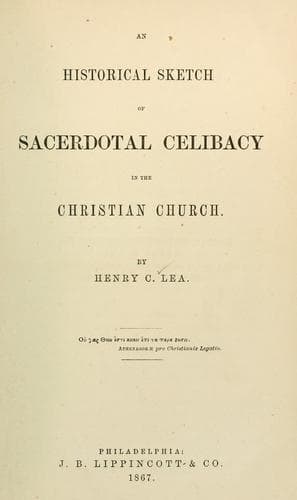
An Historical Sketch of Sacerdotal Celibacy in the Christian ChurchLea, Henry Charles
History
An Historical Sketch of Sacerdotal Celibacy in the Christian Church
Lea, Henry Charles
Catholic Church -- Clergy; Celibacy -- Catholic Church; Church history
While thus, in various ways, the ascetic spirit led to institutions
which promoted the progress of civilization, in others it necessarily
had a directly opposite tendency. Nothing contributes more strongly
to the extension of knowledge and of culture than the striving for
material comfort and individual advancement in worldly well-being.
Luxury and ambition thus have their uses in stimulating the inquiring
and inventive faculties of man, in rendering the forces of nature
subservient to our use, and in softening the rugged asperities which
are incompatible with the regular administration of law. Every
instinct of human nature has its destined purpose in life, and the
perfect man is to be found in the proportionate cultivation of each
element of his character, not in the exaggerated development of those
faculties which are deemed primarily good, nor in the entire repression
of those which are evil only when their prominence destroys the balance
of the whole. The ascetic selected for eradication one group of human
aspirations, which was the most useful under proper discipline, and
not perhaps the worst even in its ordinary excess. Only those who have
studied the varied aspects of mediæval society can rightly estimate the
enormous influence which the church possessed, in those ages of faith,
to mould the average habits of thought in any desired direction. It
can readily be seen that if the tireless preaching of the vanity of
human things and the beatitude of mortification occasionally produced
such extravagances as those of the flagellants, the spirit which now
and then burst forth in such eruption must have been an element of no
little power in the forces which governed society at large, and must
have exercised a most depressing influence in restraining the general
advance of civilization. Not only did it thus more or less weigh down
the efforts of almost every man, but the ardent minds that would
otherwise have been leaders in the race of progress were the ones most
likely, under the pervading spirit of the age, to be the foremost in
maceration and self-denial; while those who would not yield to the
seduction were either silenced or wasted their wisdom on a generation
which believed too much to believe in them. When idleness was holy,
earnest workers had little chance.
Public-domain text, read in full here on John Shaqi.
Reviews
Reviews
No reviews yet
Be the first to share your thoughts on this work.
Elsewhere in the archive
Join the Discussion
Join the discussion
Sign in to leave a comment or review.
Sign InorCreate an account