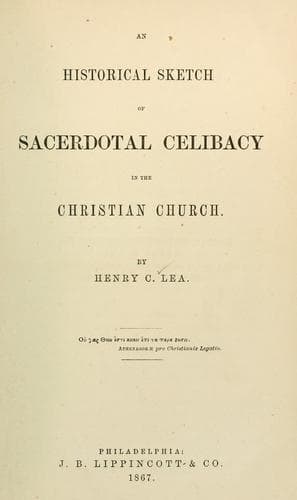
An Historical Sketch of Sacerdotal Celibacy in the Christian ChurchLea, Henry Charles
History
An Historical Sketch of Sacerdotal Celibacy in the Christian Church
Lea, Henry Charles
Catholic Church -- Clergy; Celibacy -- Catholic Church; Church history
Still, they did not even yet consider themselves as separated from
the church, for they consented to submit their peculiar doctrines to
the chances of a disputation, presided over by an orthodox priest.
Of course, the decision went against them, and a portion of the
“Poor Men of Lyons” submitted to the result. The remainder, however,
maintained their faith as rigidly as ever. From Bernard de Font-Cauld,
who records this disputation, and from Alain de l’Isle, another
contemporary, who wrote in confutation of their errors, we have a
minute account of their peculiarities of belief. Their principal
heresy was a strict adherence to the Hildebrandine doctrine that
neither reverence nor obedience was due to priests in mortal sin,
whose ministrations to the living and whose prayers for the dead
were equally to be despised. In the existing condition of sacerdotal
morals, this necessarily destroyed all reverence for the church at
large, and Bernard and Alain had no hesitation in proving it to be
most dangerously heterodox. Their recurrence to Scripture, moreover,
as the sole foundation of Christian belief, with the claim of private
interpretation, was necessarily destructive to all the forms of
sacerdotalism, and led them to entertain many other heretical tenets.
They admitted no distinction between clergy and laity. Every member of
the sect, male or female, was a priest, entitled to preach and to hear
confessions. Purgatory was denied, and the power of absolution derided.
Lying and swearing were mortal sins, and homicide was not excusable
under any circumstances.[924] Yet naturally they did not repudiate
the ascetic principles of the church, and they regarded continence as
counselled, though not commanded, by the Christian dispensation—
La ley velha maudi lo ventre que fruc non a porta,
Ma la novella conselha gardar vergeneta.[925]
Though marriage is praised and its purity is to be preserved—
Gardes ferm lo matrimoni, aquel noble convent,[926]
thus showing their disapproval of the Manichæan doctrines of the
Cathari and Paterins.
Public-domain text, read in full here on John Shaqi.
Reviews
Reviews
No reviews yet
Be the first to share your thoughts on this work.
Elsewhere in the archive
Join the Discussion
Join the discussion
Sign in to leave a comment or review.
Sign InorCreate an account