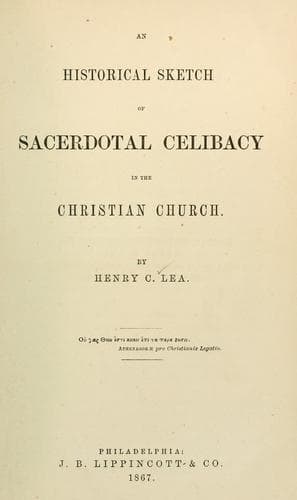
An Historical Sketch of Sacerdotal Celibacy in the Christian ChurchLea, Henry Charles
History
An Historical Sketch of Sacerdotal Celibacy in the Christian Church
Lea, Henry Charles
Catholic Church -- Clergy; Celibacy -- Catholic Church; Church history
There were not wanting those to whom even these extreme opinions were
acceptable, and Eustathius speedily accumulated around him a host
of devotees whose proselyting zeal threatened a stubborn heresy.
The excesses attributed to their inability to endure the practical
operation of their leader’s doctrines may be true, or may be merely
the accusations which are customarily disseminated when it becomes
necessary to invest schismatics with odium. Be this as it may, the
orthodox clergy felt the importance of promptly repressing opinions
which, although at variance with the creed of the church, were yet
dangerously akin to the extreme views of those who were regarded as
pre-eminently holy. Eulalius, the father of the heresiarch, himself
presided at a local synod held at Cæsarea, and condemned his son.
This did not suffice to repress the heresy, and about the year 362 a
provincial council was assembled at Gangra, where fifteen bishops,
among whom was Eulalius, pronounced their verdict on Eustathius and
his misguided followers, and drew up a series of canons defining the
orthodox belief on the questions involved. That they were received by
the church as authoritative is evident from their being included in
the collections of Dionysius and Isidor. These canons anathematize
all who refuse the sacraments of a married priest, and who hold that
he cannot officiate on account of his marriage; also those who,
priding themselves on their professed virginity, arrogantly despise
their married brethren, and who hold that the duties of wedlock are
incompatible with salvation.[106] The whole affords a singularly
distinct record of the doctrines accepted at this period, showing
that there was no authority admitted for imposing restrictions of any
kind on the married clergy. It probably was an effort on the part of
the conservatives of the church to restrain their more progressive
brethren, and they no doubt gladly availed themselves of the wild
theories of Eustathius to stigmatize the extravagances which were daily
becoming more influential. At the same time, they were careful to
shield themselves behind a qualified concession to the ascetic spirit
of the period, for in an epilogue they apologetically declare their
humble admiration of virginity, and their belief that pious continence
is most acceptable to God.[107]
* * * * *
In little more than twenty years after this emphatic denunciation of
all interference with married priests, we find the first absolute
command addressed to the higher orders of the clergy to preserve
inviolate celibacy. So abrupt a contrast provokes an inquiry into its
possible causes, as no records have reached us exhibiting any special
reasons for the change.
Public-domain text, read in full here on John Shaqi.
Reviews
Reviews
No reviews yet
Be the first to share your thoughts on this work.
Join the Discussion
Join the discussion
Sign in to leave a comment or review.
Sign InorCreate an account