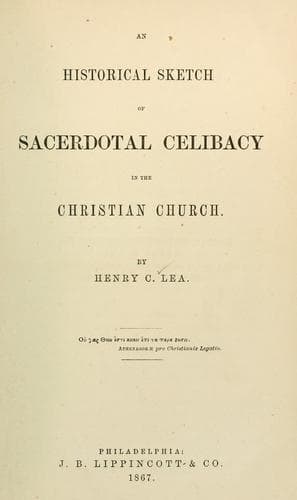
An Historical Sketch of Sacerdotal Celibacy in the Christian ChurchLea, Henry Charles
History
An Historical Sketch of Sacerdotal Celibacy in the Christian Church
Lea, Henry Charles
Catholic Church -- Clergy; Celibacy -- Catholic Church; Church history
While the admirers of ascetic virginity became louder and more
enthusiastic in their praises of that blessed condition, it is fair
to presume that they were daily more sensible of a lower standard of
morality in the ministers of the altar, and that their susceptibilities
were more deeply shocked by the introduction and growth of abuses.
While the church was kept purified by the fires of persecution, it
offered few attractions for the worldly and ambitious. Its ministry was
too dangerous to be sought except by the pure and zealous Christian,
and there was little danger that pastors would err except from
over-tenderness of conscience or unthinking ardor. When, however,
its temporal position was incalculably improved by its domination
throughout the empire, it became the avenue through which ambition
might attain its ends, while its wealth held out prospects of idle
self-indulgence to the slothful and the sensual. A new class of
men, dangerous alike from their talents or their vices, would thus
naturally find their way into the fold, and corruption, masked under
the semblance of austerest virtue, or displayed with careless cynicism,
would not be long in penetrating into the Holy of Holies. Immorality
must have been flagrant when, in 370, the temporal power felt the
necessity of interfering by a law of the Emperor Valentinian which
denounced severe punishment on ecclesiastics who visited the houses
of widows and virgins.[108] When an increasing laxity of morals thus
threatened to overcome the purity of the church, it is not surprising
that the advocates of asceticism should have triumphed over the more
moderate and conservative party, and that they should improve their
victory by seeking a remedy for existing evils in such laws as should
render the strictest continence imperative on all who entered into holy
orders. They might reasonably argue that if nothing else were gained,
the change would at least render the life of the priest less attractive
to the vicious and the sensual, and that the rigid enforcement of the
new rules would elevate the character of the church by preventing such
wolves from seeking a place among the sheep. If by such legislation
they only added fresh fuel to the flame; if they heightened immorality
by hypocrisy and drove into vagabond licentiousness those who would
perhaps have been content with lawful marriage, they only committed an
error which has ever been too common with earnest men of one idea to
warrant special surprise.
Public-domain text, read in full here on John Shaqi.
Reviews
Reviews
No reviews yet
Be the first to share your thoughts on this work.
Join the Discussion
Join the discussion
Sign in to leave a comment or review.
Sign InorCreate an account