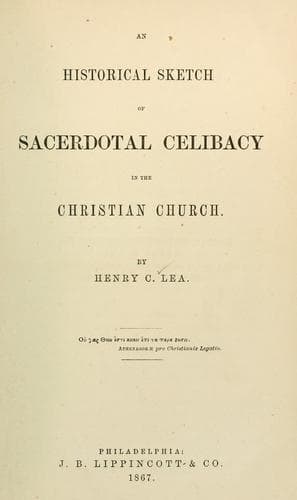
An Historical Sketch of Sacerdotal Celibacy in the Christian ChurchLea, Henry Charles
History
An Historical Sketch of Sacerdotal Celibacy in the Christian Church
Lea, Henry Charles
Catholic Church -- Clergy; Celibacy -- Catholic Church; Church history
St. Ambrose admits that although the necessity of celibacy was
generally acknowledged, still, in many of the remoter districts, there
were to be found those who neglected it, and who justified themselves
by ancient custom, relying on precautions to purify themselves for
their sacred ministry.[114] In this he gives countenance to the
tradition of the Leonistæ, simple Christians whose refusal to adapt
themselves to the sacerdotalism, which was daily becoming more rigorous
and indispensable, caused their expulsion from Rome, and who, taking
refuge in the recesses of the Cottian Alps, endeavored to preserve the
unadulterated faith of earlier times in the seclusion and privation of
exile.
All who revolted against the increasing oppression of the hierarchy
were not, however, content to bury themselves in solitude and silence,
and heresiarchs sprang up who waged a bold but unequal contest.
Bonosus, Jovinian, and Vigilantius are the names which have reached
us as the most conspicuous leaders in the unsuccessful attempt to
turn back the advancing spirit of the age, and of these Jovinian is
the foremost figure. Bonosus, who was Bishop of Sardica, acquired a
peculiarly sinister notoriety, for, in his opposition to the ascetic
spirit, he adopted a heresy of Tertullian and Photinus, and assailed
one of the chief arguments of the admirers of celibacy by denying
the perpetual virginity of the Virgin; whence his followers acquired
the euphonious title of Bonosiacs.[115] For this he was denounced by
Pope Siricius with all the vehemence which doctrines so sacrilegious
were calculated to excite,[116] and his followers were duly condemned
by the Council of Capua in 389, while the tireless pen of St. Jerome
was called into requisition to refute errors so unpardonable.[117]
Notwithstanding this they continued to flourish, for an epistle of
Innocent I. to Lawrence, Bishop of Segna, proves that the error was
openly taught on the eastern shores of the Adriatic in the early
part of the fifth century;[118] in 443 the Council of Arles shows
their existence in France by promising reconciliation to those who
should manifest proper repentance, and that of Orleans as late as 538
still contains an allusion to them.[119] The belief even extended to
Arabia, where a sect professing it is stigmatized by Epiphanius as
Antidicomarianitarians, whose conversion that worthy bishop endeavored
to secure by a long epistle, in which his labored explanations of the
stubborn text of Matthew are hardly more convincing than his hearty
objurgations of the blasphemous dogma, or his illustrative comparison
of the Virgin to a lioness bearing but one whelp.[120]
* * * * *
Public-domain text, read in full here on John Shaqi.
Reviews
Reviews
No reviews yet
Be the first to share your thoughts on this work.
Elsewhere in the archive
Join the Discussion
Join the discussion
Sign in to leave a comment or review.
Sign InorCreate an account