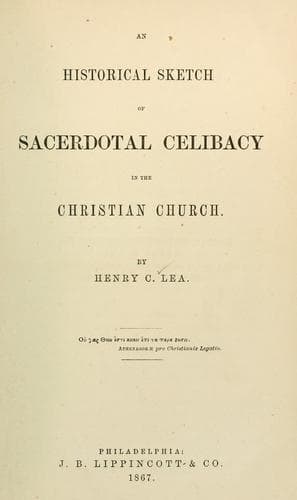
An Historical Sketch of Sacerdotal Celibacy in the Christian ChurchLea, Henry Charles
History
An Historical Sketch of Sacerdotal Celibacy in the Christian Church
Lea, Henry Charles
Catholic Church -- Clergy; Celibacy -- Catholic Church; Church history
The confident manner in which the law is thus laid down as
incontrovertible and absolute might almost make us doubt whether
it were not older than the preceding pages have shown it to be, if
Siricius had not confessed the weakness of the cause by adopting a
very different tone within a year. In 386 he addressed the church
of Africa, sending it certain canons adopted by a Roman synod. Of
these the first eight relate to observances about which there was
at that time no question, and they are expressed in the curtest and
most decisive phraseology. The ninth canon is conceived in a spirit
totally different. It persuades, exhorts, and entreats that the three
orders shall preserve their purity; it argues as to the propriety
and necessity of the matter, which it supports by various texts,
but it does not assume that the observance thus enjoined is even a
custom, much less a law, of the church; it urges that the scandal of
marriage be removed from the clergy, but it threatens no penalty for
refusal.[113] Siricius was too imperious and too earnest in all that
he undertook for us to imagine that he would have adopted pleading and
entreaty if he had felt that he possessed the right to command; nor
would he have condescended to beg for the removal of an opprobrium if
he were speaking with all the authority of unquestioned tradition to
enforce a canon which had become an unalterable part of ecclesiastical
discipline.
It is observable that in these decretals no authority is quoted later
than the Apostolic texts, which, as we have seen, have but little
bearing on the subject. No canons of councils, no epistles of earlier
popes, no injunctions of the Fathers are brought forward to strengthen
the position assumed, whence the presumption is irresistible that none
such existed, and we may rest satisfied that no evidence has been lost
that would prove the pre-existence of the rule.
V.
ENFORCEMENT OF CELIBACY.
Celibacy was but one of the many shapes in which the rapidly
progressing sacerdotalism of Rome was overlaying religion with a
multitude of formal observances. That which in earlier times had been
the spontaneous expression of fervid zeal, or the joyful self-sacrifice
of ardent asceticism, was thus changed into a law, bearing upon all
alike, and taking no count of the individual idiosyncrasies which might
render the burden too heavy for the shoulders of the less fiery though
not less conscientious Christian. That it should meet with resistance
was to be expected when we consider that the local independence of
primitive times had not as yet been crushed under the rapidly growing
preponderance of the Roman see. In fact energetic protests were not
wanting, as well as the more perplexing stubbornness of passive
resistance.
Public-domain text, read in full here on John Shaqi.
Reviews
Reviews
No reviews yet
Be the first to share your thoughts on this work.
Join the Discussion
Join the discussion
Sign in to leave a comment or review.
Sign InorCreate an account