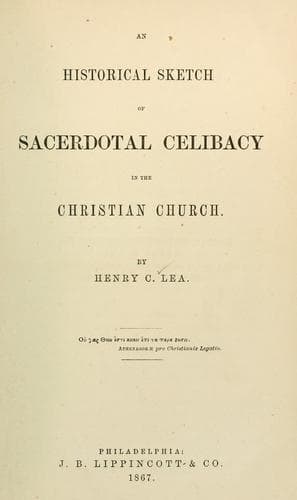
An Historical Sketch of Sacerdotal Celibacy in the Christian ChurchLea, Henry Charles
History
An Historical Sketch of Sacerdotal Celibacy in the Christian Church
Lea, Henry Charles
Catholic Church -- Clergy; Celibacy -- Catholic Church; Church history
Nor was this the only struggle. A wild shepherd lad named Vigilantius,
born among the Pyrenean valleys, was fortunate enough to be the slave
of St. Sulpicius Severus, whose wealth, culture, talents, and piety
rendered him prominent throughout Southern Gaul. The earnest character
of the slave attracted the attention of the master; education developed
his powers; he was manumitted, and the people of his native Calagurris
choose him for their priest. Sent by Sulpicius as bearer of letters
to his friends St. Paulinus at Nola, and St. Jerome in his Bethlehem
retreat, Vigilantius had the opportunity of comparing the simple
Christianity of his native mountains with the splendid pageantry of
Rome, the elegant retirement of Nola, and the heated controversialism
which agitated the asceticism of Bethlehem. Notwithstanding the
cordiality of their first acquaintance, his residence with Jerome was
short. Both were too earnestly dogmatic in their natures for harmony
to exist between the primitive Cantabrian shepherd and the fierce
apostle of Buddhist and Mazdean Christianity, who devoted his life
to reconciling the doctrines of the Latin church with the practices
of Manichæism. Brief friendship ended in a quarrel, and Vigilantius
extended his experiences by a survey of Egypt, where the vast hordes of
Nitrian anchorites were involved in civil strife over the question of
Origenism. Returning through Italy, he tarried in Milan and among the
Alps, where he found the solution of his doubts and the realization of
his ideas in the teaching of Jovinian. He had left Gaul a disciple; he
returned to it a missionary, prepared to do battle with sacerdotalism
in all its forms. Not only did he deny the necessity of celibacy, but
he pronounced it to be the fertile source of impurity, and in his
zeal for reform he swept away fasting and maceration, he ridiculed
the adoration of relics, and pronounced the miracles wrought at their
altars to be the work of demons; he objected to the candles and incense
around the shrines, to prayers for the dead, and to the oblations of
the faithful.[126]
Public-domain text, read in full here on John Shaqi.
Reviews
Reviews
No reviews yet
Be the first to share your thoughts on this work.
Elsewhere in the archive
Join the Discussion
Join the discussion
Sign in to leave a comment or review.
Sign InorCreate an account