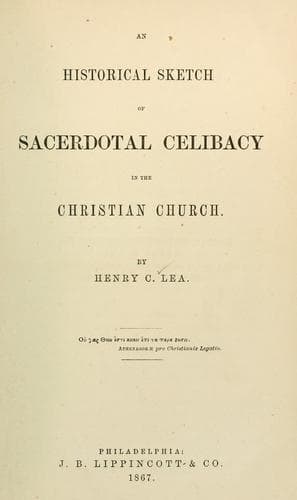
An Historical Sketch of Sacerdotal Celibacy in the Christian ChurchLea, Henry Charles
History
An Historical Sketch of Sacerdotal Celibacy in the Christian Church
Lea, Henry Charles
Catholic Church -- Clergy; Celibacy -- Catholic Church; Church history
No doubt the decretals of Siricius had rendered compulsory the
celibacy of the priesthood throughout Gaul and Spain. The machinery
of the hierarchy may readily have stifled open opposition, however
frequent may have been the secret infractions of the rule. This may
perhaps have contributed to the success of Vigilantius. Even his
former master, St. Sulpicius Severus, and St. Exuperius, Bishop of
Toulouse, were inclined to favor his reforms. That they spread with
dangerous rapidity throughout Gaul from south to north is shown by
the fact that in 404 Victricius, Bishop of Rouen, and in 405 St.
Exuperius of Toulouse applied to Innocent I. for advice as to the
manner in which they should deal with the new heresy. It also counted
numerous adherents throughout Spain, among whom even some bishops were
enumerated. The alarm was promptly sounded, and the enginery of the
church was brought to bear upon the hardy heretic. The vast reputation
and authority of Jerome lent force to the coarse invective with which
he endeavored to overwhelm his whilom acquaintance, and though the
nickname of Dormitantius which he bestowed on Vigilantius was a sarcasm
neither very severe nor very refined, the disgusting exaggeration of
his adversary’s tenets in which he as usual indulged had doubtless
its destined effect.[127] Pope Innocent was not backward in asserting
the authority of Rome and the inviolable nature of the canon. In his
epistle to Victricius, he repeated the decretal of Siricius, but in a
somewhat more positive form;[128] while in the following year (405)
he confirmed the vacillating faith of Exuperius by declaring that any
violation of the strictest celibacy on the part of priest or deacon
subjects the offender to the deprivation of his position.[129] As in
the previous effort of Siricius, however, ignorance is admitted as an
excuse, entitling him who can plead it to retain his grade without hope
of preferment—and the test of this ignorance is held to be the canon of
385. This latter point is noteworthy, for it is a tacit confession of
the novelty of the rule, although Innocent labored at great length to
prove both its antiquity and necessity from the well-known texts of St.
Paul and the Levitical observances. Yet no intermediate authority was
quoted, and punishment was only to be inflicted on those who could be
proved to have seen the decretal of Siricius.
Public-domain text, read in full here on John Shaqi.
Reviews
Reviews
No reviews yet
Be the first to share your thoughts on this work.
Elsewhere in the archive
Join the Discussion
Join the discussion
Sign in to leave a comment or review.
Sign InorCreate an account