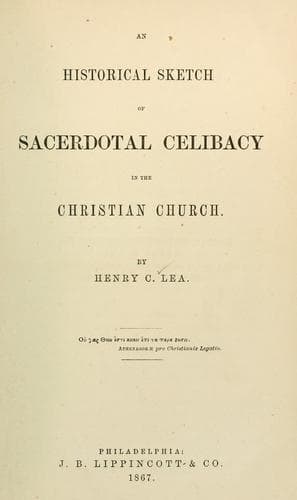
An Historical Sketch of Sacerdotal Celibacy in the Christian ChurchLea, Henry Charles
History
An Historical Sketch of Sacerdotal Celibacy in the Christian Church
Lea, Henry Charles
Catholic Church -- Clergy; Celibacy -- Catholic Church; Church history
ordering the separation of the married clergy of the higher grades from
their wives, under pain of deprivation of office.[132] As before, the
form of the canon shows it to be an innovation.
That the rule was positively adopted and frequently submitted to is
shown by St. Augustin, who, in his treatise against second marriages,
states that, in arguing with those desirous of entering upon those
unhallowed unions, he was accustomed to strengthen his logic by citing
the continence of the clergy, who, however unwillingly they had in
most cases been forced to undertake the burden, still, by the aid of
God, were enabled to endure it to the end.[133] Yet it is evident
that its enforcement was attended with many difficulties and much
opposition, for, twenty years later, at another council of Carthage,
we find Faustinus, the Papal Legate, proposing that the three higher
orders shall be separated from their wives, to which the fathers of the
council somewhat evasively replied that those who were concerned in
the ministry of the altar should be chaste in all things. No attempt,
however, was apparently made to strengthen the resolution by affixing a
penalty for its infringement. It was a simple declaration of opinion,
and nothing more.[134]
Symptoms of similar difficulty in the rigid enforcement of the canon
are observable elsewhere. The proceedings of the first council of
Toledo, held in the year 400, shows not only that it was a recent
innovation which continued to be disregarded, but that it had given
rise to a crowd of novel questions which required imperatively to be
settled, as to the status of the several grades of clerks who were
guilty of various forms of disobedience[135]—the prototype and examplar
of innumerable similar attempts at legislation which continued for more
than a thousand years to occupy a good part of the attention of almost
every council and synod. The prelates of Cis-Alpine Gaul, assembled
in the council of Turin in 401, could only be brought to pronounce
incapable of promotion those who contravened the injunction which
separated them from their wives.[136] The practical working of this was
to permit those to retain their wives who were satisfied with the grade
to which they had attained. Thus the priest, who saw little prospect
of elevation to the episcopate, might readily console himself with the
society of his wife, while the powerful influence of the wives would
be brought to bear against the promptings of ambition on the part of
their husbands. The punishment thus was heaviest on the lower grades
and lightest on the higher clergy, whose position should have rendered
the sin more heinous—in fact, the bishop, to whom further promotion was
impossible, escaped entirely from the penalty.
Public-domain text, read in full here on John Shaqi.
Reviews
Reviews
No reviews yet
Be the first to share your thoughts on this work.
Elsewhere in the archive
Join the Discussion
Join the discussion
Sign in to leave a comment or review.
Sign InorCreate an account