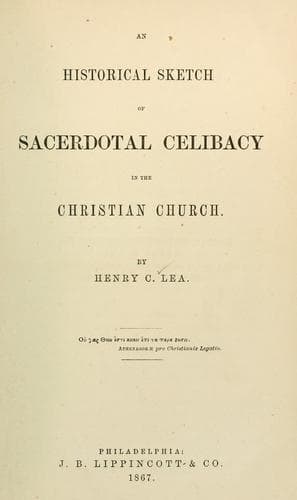
An Historical Sketch of Sacerdotal Celibacy in the Christian ChurchLea, Henry Charles
History
An Historical Sketch of Sacerdotal Celibacy in the Christian Church
Lea, Henry Charles
Catholic Church -- Clergy; Celibacy -- Catholic Church; Church history
Even as late as 441 the first council of Orange shows how utterly the
rule had been neglected by ordering that for the future no married man
should be ordained deacon without making promise of separation from
his wife, for contravention of which he was to suffer degradation;
while those who had previously been admitted to orders were only
subjected to the canon of the council of Turin, incurring merely loss
of promotion.[137] This evidently indicates that the regulation was
a novelty, for it admits the injustice of subjecting to the rigor
of the canon those who had taken orders without being aware of the
obligations incurred; and it is a fair conclusion to suppose that this
was a compromise by which the existing clergy gave their assent to the
rule for the benefit of their successors, provided that they themselves
escaped its full severity. In fact, it seemed to be impossible to
make the church of Gaul accept the rule of discipline. About 459, we
find Leo I., in answer to some interrogatories of Rusticus, Bishop
of Narbonne, laboriously explaining that deacons and subdeacons, as
well as bishops and priests, must treat their wives as sisters.[138]
Rusticus had evidently asked the question, and Leo expresses no
surprise at his ignorance.
The Irish Church, founded about the middle of the fifth century,
although it was to a great extent based on monachism, apparently did
not at first order the separation of the sexes. A century later an
effort seems to have been made in this direction; but the canons of a
synod held in the early part of the eighth century show that priests at
that time were not prevented from having wives.[139]
Even where the authority of the decretals of Siricius and Innocent was
received with respectful silence, it was not always easy to enforce
their provisions. An epistle of Innocent to the bishops of Calabria
shows that, within territory depending strictly upon Rome itself, a
passive resistance was maintained, requiring constant supervision and
interference to render the rule imperative. Some priests, whose growing
families rendered their disregard of discipline as unquestionable as it
was defiant, remained unpunished. Either the bishops refused to execute
the laws, or their sympathies were known to be with the offenders, for
the pious layman whose sensibilities were wounded by the scandal felt
himself obliged to appeal to the Pope. Innocent accordingly ordered the
accused to be tried and to be expelled, while he expressed no little
surprise at the negligence of the prelates who were so remiss.[140] It
is more difficult to understand the edict of 420, issued by Honorius,
to which allusion has already been made (p. 55). This law expressly
declares that the desire for purity does not require the separation of
wives whose marriage took place before the ordination of their husbands.
Public-domain text, read in full here on John Shaqi.
Reviews
Reviews
No reviews yet
Be the first to share your thoughts on this work.
Elsewhere in the archive
Join the Discussion
Join the discussion
Sign in to leave a comment or review.
Sign InorCreate an account