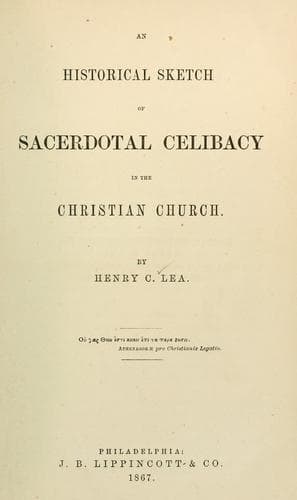
An Historical Sketch of Sacerdotal Celibacy in the Christian ChurchLea, Henry Charles
History
An Historical Sketch of Sacerdotal Celibacy in the Christian Church
Lea, Henry Charles
Catholic Church -- Clergy; Celibacy -- Catholic Church; Church history
Another segment of the Eastern church may properly receive attention
here. The Abyssinians and Coptic Christians of Egypt can scarcely
in truth be considered a part of the Greek church, as they are
monophysite in belief, and have in many particulars adopted Jewish
customs, such as circumcision, &c. Their observances as regards
marriage, however, tally closely with the canons of the Quinisext,
except that bishops are permitted to retain their wives. In the
sixteenth century, Bishop Zaga Zabo, who was sent as envoy to Portugal
by David, King of Abyssinia, left behind him a confession of faith
for the edification of the curious. In this document he describes
the discipline of his church as strict in forbidding the clericature
to illegitimates; marriage is not dissolved by ordination, but
second marriage, or marriage in orders, is prohibited, except under
dispensation from the Patriarch, a favor occasionally granted to
magnates for public reasons. Without such dispensation, the offender
is expelled from the priesthood, while a bishop or other ecclesiastic
convicted of having an illegitimate child is forthwith deprived of all
his benefices and possessions. Monasteries, moreover, were numerous and
monachal chastity was strictly enforced.[183] These rules, I presume,
are still in force. A recent traveller in those regions states that “if
a priest be married previous to his ordination, he is allowed to remain
so; but no one can marry after having entered the priesthood”—while a
mass of superstitious and ascetic observances has overlaid religion,
until little trace is left of original Christianity.[184]
VII.
MONACHISM.
The Monastic Orders occupy too prominent a place in ecclesiastical
history, and were too powerful an instrument both for good and evil,
to be passed over without some cursory allusion, although the secular
clergy is more particularly the subject of the present sketch, and the
rise and progress of monachism is a topic too extensive in its details
to be thoroughly considered in the space which can be allotted to it.
Public-domain text, read in full here on John Shaqi.
Reviews
Reviews
No reviews yet
Be the first to share your thoughts on this work.
Elsewhere in the archive
Join the Discussion
Join the discussion
Sign in to leave a comment or review.
Sign InorCreate an account