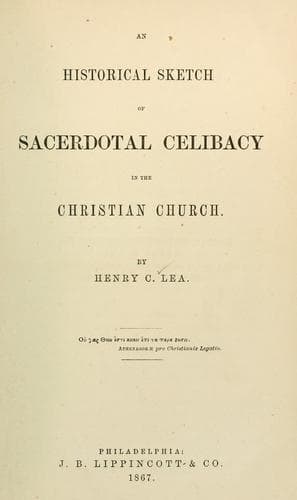
An Historical Sketch of Sacerdotal Celibacy in the Christian ChurchLea, Henry Charles
History
An Historical Sketch of Sacerdotal Celibacy in the Christian Church
Lea, Henry Charles
Catholic Church -- Clergy; Celibacy -- Catholic Church; Church history
The episcopal chair, which at an earlier period had been filled by the
votes of the people, and which subsequently came under the control
of the Papacy, was at this time a gift in the hands of the untamed
Merovingians, who carelessly bestowed it on him who could most lavishly
fill the royal coffers, or who had earned it by courtly subservience
or warlike prowess. The supple Roman or the turbulent Frank, who
perchance could not recite a line of the Mass, thus leaped at once from
the laity through all the grades;[248] and as he was most probably
married, there can be no room for surprise if the rule of continence,
thus suddenly assumed from the most worldly motives, should often prove
unendurable. Even in the early days of the Frankish conquest we see a
cultured noble, like Genebaldus, married to the niece of St. Remy, when
placed in the see of Laon ostensibly putting his wife away and visiting
her only under pretext of religious instruction, until the successive
births of a son and a daughter—whom he named Latro and Vulpecula in
token of his sin—and we may not unreasonably doubt the chronicler’s
veracity when he informs us that the remorse of Genebaldus led him
to submit to seven years’ imprisonment as an expiatory penance.[249]
Equally instructive is the story of Felix of Nantes, whose wife,
banished from his bed on his elevation to the episcopate, rebelled
against the separation, and, finding him obdurate to her allurements,
was filled with jealousy, believing that only another attachment could
account for his coldness. Hoping to detect and expose his infidelity,
she stole into the chamber where he was sleeping and saw on his breast
a lamb, shining with heavenly light, indicative of the peaceful repose
which had replaced all earthly passions in his heart.[250] A virtue
which was regarded as worthy of so miraculous a manifestation must
have been rare indeed among the illiterate and untutored nominees of
a licentious court, and that it was so in fact is indicated by the
frequent injunctions of the councils that bishops must regard their
wives as sisters; while a canon promulgated by the council of Macon,
in 581, ordering that no woman should enter the chamber of a bishop
without two priests, or at least two deacons, in her company, shows how
little hesitation there was in publishing to the world the suspicions
that were generally entertained.[251] How the rule was sometimes obeyed
by the wild prelates of the age, while trampling upon other equally
well-known canons, is exemplified by the story of Macliaus of Britanny.
Chanao, Count of Britanny, had made way with three of his brothers; the
fourth, Macliaus, after an unsuccessful conspiracy, sought safety in
flight, entered the church, and was created Bishop of Vannes. On the
death of Chanao, he promptly seized the vacant throne, left the church,
threw off his episcopal robes, and took back to himself the wife whom
he had quitted on obtaining the see of Vannes—for all of which he was
Public-domain text, read in full here on John Shaqi.
Reviews
Reviews
No reviews yet
Be the first to share your thoughts on this work.
Elsewhere in the archive
Join the Discussion
Join the discussion
Sign in to leave a comment or review.
Sign InorCreate an account