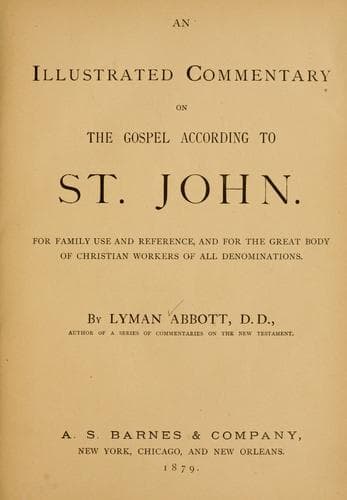
An illustrated commentary on the Gospel according to St. JohnAbbott, Lyman
Religion
An illustrated commentary on the Gospel according to St. John
Abbott, Lyman
Bible. John -- Commentaries
=24. Verily, verily, I say unto you, He that heareth me and hath faith
on him that sent me, hath eternal life, and comes not into judgment,
but has passed out of the death into the life.= The meaning of this
declaration is not obscure, though it has been sometimes obscured by
unbelief. To _hear the word of Christ_ is to hear it with the
spiritual ear, not merely with the physical ear. Thus those may be
included who have never heard of the historic Christ; for as he is the
Light of the world, who lighteth _every man_ who cometh into the world
(ch. 1:9, note), so those who, without the literal hearing of his
words, do hear and attend to the message which he speaks to the soul,
in the inner experience, are to be included among those who hear his
words. To _have faith on him that sent me_, is not merely to believe
his written word, nor to believe that he has sent Christ into the
world, nor to believe any specific dogma respecting Christ, however
important, but to have faith in an unseen divinity, in contrast to
faith in either one’s self or in any human helper. It is to direct
faith toward this unseen God that Christ came into the world; and to
have faith in Christ is to have faith in the Father who sent him, in
order that he might bring all unto the Father, and present all to him
(ch. 17:8, 21, 24). _Cometh not into judgment_ is mistranslated in our
English version, _Shall not come into condemnation_. The verb is not
future, and the noun is judgment, not condemnation. “There can be no
good reason why the word (κρίσις, _krisis_) should be rendered
_judgment_ in the 22d verse, and _condemnation_ in the 24th. But from
a fear, I suppose, lest the one should seem to contradict the
other--lest the Son should be thought not to execute the judgment that
had been committed to him--they (the translators) were unfaithful to
the letter, perhaps even more unfaithful to the spirit, of the
passage.”--(_Maurice._) The promise is one fulfilled in this life, a
promise of present not merely future deliverance, and of a deliverance
not merely from condemnation, but from judgment. If the Christian
comes into judgment, he would also inevitably come into condemnation
(1 John 1:8, 10). The meaning of this verse then is, that when the
soul has accepted Christ as its Master, hearing his words, and
following him, for spiritual hearing involves following (ch. 10:3, 4)
so as to live by faith in God (Gal. 2:20), he is no longer subject to
divine judgment; there is no more condemnation to them who are thus in
Christ Jesus (Rom. 8:1). With this is involved the further truth that
there will be no true judgment for them in the last day. “The
reckoning which ends with ‘Well done, good and faithful servant,’ is
not judgment; the reward is of free grace. In this sense the believers
in Christ will not be judged according to their works; they are
justified before God by faith, and by God.”--(_Alford._) Finally, the
last clause of the verse, _but hath passed out of death into life_,
Public-domain text, read in full here on John Shaqi.
Reviews
Reviews
No reviews yet
Be the first to share your thoughts on this work.
Elsewhere in the archive
Join the Discussion
Join the discussion
Sign in to leave a comment or review.
Sign InorCreate an account