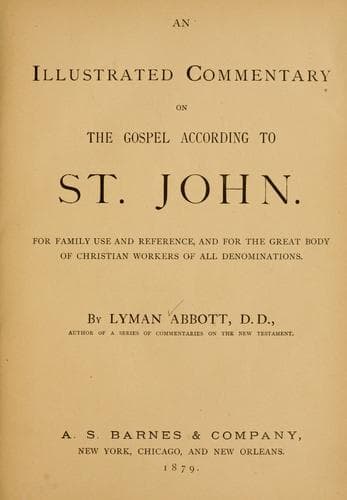
An illustrated commentary on the Gospel according to St. JohnAbbott, Lyman
Religion
An illustrated commentary on the Gospel according to St. John
Abbott, Lyman
Bible. John -- Commentaries
Various attempts have been made to explain this miracle on
rationalistic principles. The two principal explanations offered are:
(1) that the people were so satisfied with Christ’s instruction that
they did not feel the claims of hunger (_Schenkel_); (2) that they had
their hearts opened by the beneficence of Christ, so that those who
possessed food themselves provided for those that had none, and thus
all were furnished by a miracle of love, operating not by the literal
creation of new supplies, but by the inspiration of a new spirit of
benevolence in the people themselves. This, if I understand him
aright, is Lange’s explanation. See his _Life of Christ_, Vol. II, p.
140. For a more elaborate classification of rationalistic theories,
see _Lange’s Commentary on Matthew_, Am. ed., p. 266. Neither
interpretation deserves serious refutation. The first is inconsistent
with the fact that twelve baskets of the fragments were gathered up
after the meal was ended; the second is contradicted by the language
of the disciples, who plainly imply that the people are without food
(Matt. 14:15; Mark 6:36; Luke 9:12), and by the enthusiasm of the
people after the miracle has been performed. They were not of a kind
to be ready to crown a prophet as king, merely because he had opened
their hearts and inclined them to benevolence. It is, however, to be
noted that here as elsewhere the Evangelists simply state the facts,
leaving the reader to make his own deductions. These facts are that
over 5,000 people were upon a plain, without provisions; that all the
food which Christ had for them was five loaves and two small fishes;
that he distributed this to the twelve, and they to the multitude;
that all had enough; and that when the meal was over there were twelve
baskets full of fragments remaining. Assuming these to be the facts,
the explanation of a miraculous creation of bread is the only
reasonable explanation; any other hypothesis impugns the historical
verity of the four Gospels. The attempt to explain the miracle as an
acceleration of the processes of nature (_Olshausen_), to which, as
Dr. Schaff well says, “must be added an accelerated process of art, or
the combined labors of the reaper, miller, and baker,” gives no help
in understanding the process by which Christ provided for all. We can
accept the fact without comprehending the method, which is indeed as
entirely incomprehensible as are God’s methods in the ordinary
phenomena of nature, _e. g._, the multiplication of a single kernel of
corn into the many kernels upon the stalk. The parallel and contrast
between this miracle and the analogous but different multiplication of
food wrought by the O. T. prophets Elijah and Elisha (1 Kings 17:16; 2
Kings 4:42-44) are instructive. Like all of Christ’s miracles, this
multiplication is a parable. (1) It illustrates Christ’s method: the
way to men’s hearts is often through ministering to their bodies; in
Public-domain text, read in full here on John Shaqi.
Reviews
Reviews
No reviews yet
Be the first to share your thoughts on this work.
Elsewhere in the archive
Join the Discussion
Join the discussion
Sign in to leave a comment or review.
Sign InorCreate an account