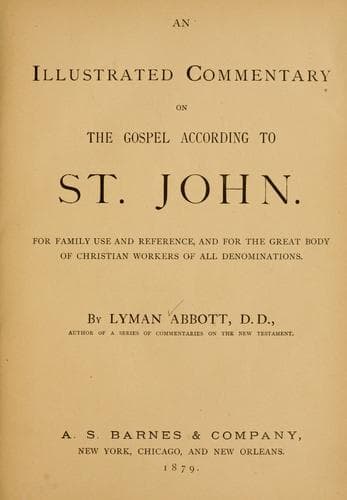
An illustrated commentary on the Gospel according to St. JohnAbbott, Lyman
Religion
An illustrated commentary on the Gospel according to St. John
Abbott, Lyman
Bible. John -- Commentaries
=39, 40. And this is the will of him that sent me, that the all which
he has given me, from it I should lose nothing, but shall raise it up
in the last day.= In omitting the word Father from verse 39 and
inserting it in verse 40 I follow the best MSS. See _Alford_. The
resurrection here spoken of is the resurrection of life, _i. e._, unto
eternal life (ch. 5:29), which is given only through Christ (ch.
11:25; Phil. 3:10, 11).--=For this is the will of my Father, that
every one= (πᾶς, not πᾶν), masculine, not neuter; the _whole_ is given
to the Son; but each one must come by and for himself to the
Son.--=Seeing the Son.= Looking unto him, as those bitten in the
wilderness looked unto the brazen serpent (ch. 3:14, 15; Numb. 21:9;
Isa. 45:22).--=And having faith in him.= Making Christ the substance
of his hope as well as the object of his faith (Heb. 11:1; ver. 29,
note).--=May have eternal life; and I will raise him up at the last
day.= These verses clearly imply (1) that there is nothing in any
secret decree or election of God, or in the nature or extent of the
provisions of divine grace, to limit the gift of eternal life or
prevent any one from receiving it through faith in the Son; (2) that
the only condition required is one inherent in the nature of the case,
namely, a sincere belief in, and desire for, that spiritual life which
alone is eternal and of which Christ is the supreme manifestation; (3)
that whoever has once thus looked to Christ with living faith has an
absolute assurance of preservation from the weakness of his own will,
as well as from external temptation, an assurance afforded by Christ’s
declaration, “Of all which he has given me I shall lose nothing.” It
does not imply a literal bodily resurrection. The literalism which so
reads this promise is akin to that which misinterpreted Christ’s
language respecting eating his flesh and drinking his blood. The whole
spirit and tone of this discourse is poetic and metaphorical.
41 The Jews then murmured at him, because he said, I am the
bread which came down from heaven.
42 And they said, Is[232] not this Jesus, the son of
Joseph, whose father and mother we know? how is it then
that he saith, I came down from heaven?
[232] Matt. 13:55; Mark 6:3; Luke 4:22.
Public-domain text, read in full here on John Shaqi.
Reviews
Reviews
No reviews yet
Be the first to share your thoughts on this work.
Elsewhere in the archive
Join the Discussion
Join the discussion
Sign in to leave a comment or review.
Sign InorCreate an account