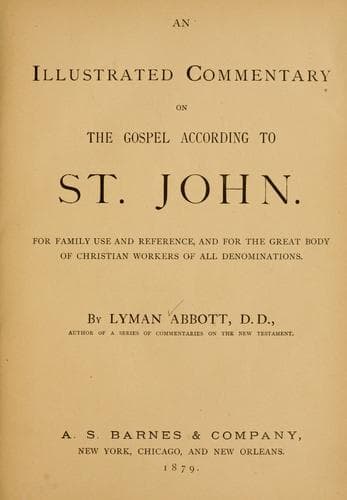
An illustrated commentary on the Gospel according to St. JohnAbbott, Lyman
Religion
An illustrated commentary on the Gospel according to St. John
Abbott, Lyman
Bible. John -- Commentaries
=43-45. Jesus therefore answered=, * * * * =No one= (not, _no man_)
=can come unto me except the Father which has sent me draw him=.
Parallel to this declaration is that of Matt. 16:17; the true
knowledge of Christ is revealed to the soul by the Father. There has
been much theological discussion as to the proper interpretation of
this passage. On the one hand, Calvin declares that “it is therefore a
false and profane assertion, that none are _drawn_ but those who are
willing to be _drawn_, as if man made himself obedient to God by his
own efforts; for the willingness with which men follow God is what
they already have from himself, who has framed their hearts to obey
him;” on the other hand, Adam Clark, representing the Arminian school
of theology, thus interprets the divine drawing: “A man is attracted
by that which he delights in. Show green herbage to a sheep, he is
drawn by it; show nuts to a child, and he is drawn by them. They run
wherever the person runs who shows these things; they run after him,
but they are not forced to follow; they run through the desire they
feel to get the things they delight in. So God draws man; he shows him
his wants--he shows the Saviour whom he has provided for him.” The
true interpretation of the declaration involves the long disputed and
yet unsettled problem of the psychology of the will, what is the
nature of and what are the limits to its freedom of action, a problem
which belongs rather to the domain of mental science than to that of
theology or Biblical interpretation. In interpreting this passage,
however, the student should consider: (1) the literal meaning of the
word draw (ἕλκω). This primarily carries with it the idea of force,
and is used by Homer of carrying one away captive; by Luke, of
dragging persons before a court (Acts 16:19; comp. James 2:6); and by
John himself of dragging a net (ch. 21:6, 11). Thus the metaphor
involved in the word implies at least a certain resistance to the
divine love and a certain difficulty to be overcome by the divine
drawing. (2) Parallel teachings in the O. T. and N. T. (comp. Sol.
Song 4:1; Jer. 31:3; Hos. 11:4; Luke 14:23, note; John 12:32; 1 Cor.
1:9), where the word _called_ is parallel to the word _draw_ here
(Phil. 2:12, 13). (3) Christ’s own interpretation of the Father’s
drawing, afforded by ver. 45. They that have learned of the Father are
they that are drawn by him. (4) The nature of that coming to Christ
which is the object of the divine drawing. “We do not come to Christ
by walking, but by believing; not by the movement of the body, but by
the free will of the heart. * * * * Think not that thou art drawn
against thy will, for the mind is drawn by love.”--(_Augustine._)
Interpreting this passage in the light of these considerations, I
understand not that God drags the unwilling by an irresistible grace,
nor merely the willing by placing before the will in its natural
condition such objects--a sense of its needs and a revelation of its
Public-domain text, read in full here on John Shaqi.
Reviews
Reviews
No reviews yet
Be the first to share your thoughts on this work.
Elsewhere in the archive
Join the Discussion
Join the discussion
Sign in to leave a comment or review.
Sign InorCreate an account