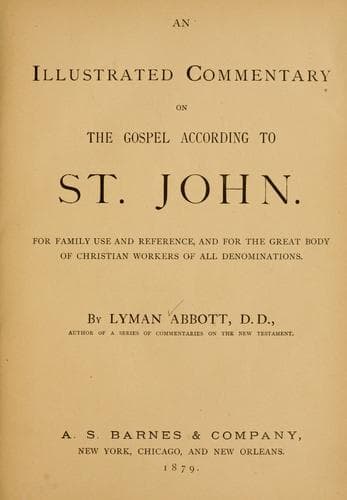
An illustrated commentary on the Gospel according to St. JohnAbbott, Lyman
Religion
An illustrated commentary on the Gospel according to St. John
Abbott, Lyman
Bible. John -- Commentaries
=53-55. Therefore Jesus said unto them.= Therefore connects what
follows with what has preceded; he emphasizes and explains the eating
and drinking, in response to their interruption in ver. 53.--=Verily,
verily, I say unto you.= These words give a solemn emphasis to the
declaration which follows.--=Except ye eat the flesh of the Son of
man.= That is, of the Messiah (Matt. 10:23, note).--=And drink his
blood.= The use of animal blood in any form was prohibited to the
Israelites as food (Gen. 9:4; Lev. 3:17; 7:26, 27; 17:10-14; 19:26;
Deut. 12:16, 23; 15:23), and was exceedingly odious to the Jewish
thought. Moreover, to touch even the corpse of a man rendered the Jew
unclean. It is not, therefore, strange that Christ’s language here
should have offended many even of his disciples (ver. 60).--=Ye have
no life in you.= The mere physical life is accounted in the N. T. no
life at all. The true life is that of God in the soul, the absence of
which is death.--=Whoso eateth my flesh.= The Greek verb rendered in
both places _eat_ is different from that used above. The word here
(τρώγω) signifies literally to _chew_ or _masticate_, and seems to me
to have been substituted by Christ for the more general one (φαγεῖν),
in order to add still further emphasis to the doctrine which he is
expounding.--=And drinketh my blood, hath eternal life.= A present
possession. See ver. 47, note.--=And I will raise him up at the last
day.= This is one of the passages on which the advocates of the
doctrine of conditional immortality base their belief. The promise of
resurrection here certainly is limited to those who through faith have
received the gift of eternal life.--=For my flesh is true meat and my
blood is true drink.= To Christ the material universe was but a
shadow, and the realities were those things of which the material
universe is a type. “Food and drink are not here mere metaphors;
rather are our common material food and drink mere shadows and
imperfect types of this only real reception of refreshment and
nourishment into the being.”--(_Alford._) In the interpretation of
Christ’s language here, the student must remember the declaration
respecting him, “Without a parable spake he not unto them” (Mark
4:34); unquestionably the language here is parabolic. It is also true
that the phrases eating and drinking were used among the Jews in a
metaphorical sense, and that bread especially was employed among them
as a symbol for doctrine (Isa. 3:1; Jer. 15:16; Lightfoot on John
6:51; Geikie’s Life of Christ, ch. 44, note c). It seems to me,
however, very clear not only that Christ here means something more
than receiving his doctrines, but that he employs his peculiar
language for the express purpose of emphasizing the truth that it is
not merely enough to receive him as a teacher. If this had been his
meaning, it would have been easy to correct the misapprehension of his
Jewish hearers, and remove the offence which they felt at his
discourse. This he does not do.
Public-domain text, read in full here on John Shaqi.
Reviews
Reviews
No reviews yet
Be the first to share your thoughts on this work.
Elsewhere in the archive
Join the Discussion
Join the discussion
Sign in to leave a comment or review.
Sign InorCreate an account