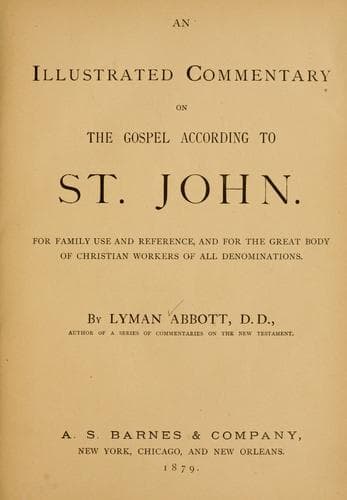
An illustrated commentary on the Gospel according to St. JohnAbbott, Lyman
Religion
An illustrated commentary on the Gospel according to St. John
Abbott, Lyman
Bible. John -- Commentaries
64 But there are some of you that believe not. For Jesus
knew[254] from the beginning who they were that believed
not, and who should betray him.
[254] Rom. 8:29; 2 Tim. 2:19.
65 And he said, Therefore said I[255] unto you, that no
man can come unto me, except it were given unto him of my
Father.
[255] verses 44, 45.
=64, 65. But there are some among you who have not faith.= Such could
not receive the teaching of Christ, for it is true in spiritual as in
physical gifts, according to one’s faith, so is Christ’s blessing
(Matt. 9:29).--=For Jesus knew from the beginning=, etc. Compare this
distinct statement of Christ’s foreknowledge with Christ’s own
statement of the limitations of his knowledge in Mark 13:32. The
contrast illustrates one of the inexplicable mysteries of Christ’s
nature, whose knowledge transcended that of man, yet in his earthly
condition was less than that of omniscience. To the question, Why, if
he foreknew the betrayal of Judas, did he ordain him as an apostle?
there is no satisfactory answer. The problem of divine foreknowledge
and human free-will, of that divine law the inflexibility of which
science has in these later days so strikingly demonstrated, and that
freedom of moral action to which universal consciousness testifies, is
one which transcends the limits of the human intellect.--=Therefore
said I unto you that no one can come unto me except it were given unto
him of my Father.= Judas and the withdrawing disciples had, in a
sense, come unto him; they had followed him, accepted him as their
Master, and had given him for a time their allegiance. Yet they had
not really come to him, for no one truly comes except he is drawn by a
divine influence. _Therefore_ connects the declaration of ver. 44 with
the fact here stated that some of the disciples were without true
faith. The practical warning to us here is this, that we have need to
examine ourselves that we may know whether our coming to Christ has
been merely that of a natural inclination or that of obedience to the
impulse of the Spirit of God.
66 From that _time_ many of his disciples went back,[256]
and walked no more with him.
[256] Zeph. 1:6; Luke 9:62; Heb. 10:38.
67 Then said Jesus unto the twelve, Will ye also go away?
Public-domain text, read in full here on John Shaqi.
Reviews
Reviews
No reviews yet
Be the first to share your thoughts on this work.
Elsewhere in the archive
Join the Discussion
Join the discussion
Sign in to leave a comment or review.
Sign InorCreate an account