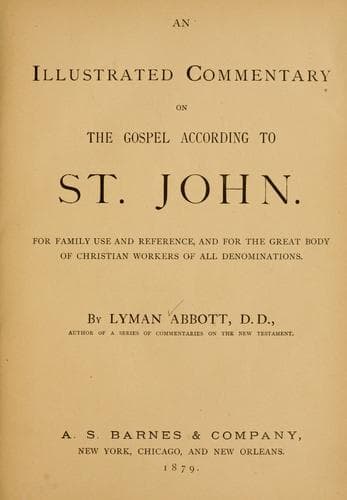
An illustrated commentary on the Gospel according to St. JohnAbbott, Lyman
Religion
An illustrated commentary on the Gospel according to St. John
Abbott, Lyman
Bible. John -- Commentaries
4 For _there is_ no man _that_ doeth anything in secret,
and he himself seeketh to be known openly. If thou do these
things, shew thyself to the world.
=2-4. Now the Jews’ feast of Tabernacles was at hand.= This was one of
the three greater festivals to be observed by Israel. It was also
called the feast of Ingathering, from the fact that it was held at the
year’s end, when all the labors of the field were consummated. It thus
resembled nearly our own Thanksgiving Day. It commenced on the
fifteenth of the seventh month, answering to our October, and lasted
seven days. It was instituted to commemorate the dwelling in tents
when in the desert; accordingly, while the feast lasted the people
dwelt in booths or tents placed on the flat roofs of the houses, in
the courts of the temple, and in the squares and open places, and the
streets when their width allowed. The particular sacrifices to be
offered are detailed in Num. 29:1-38, and notices of the observance
are to be found in Neh. 8:13-18; Hos. 12:9; Zech. 14:16-19.--=His
brethren.= Their names are given in Matt. 13:55. I believe his half
brothers, children of Joseph and Mary, are intended. See Note on
Brethren of the Lord, Vol. I, p. 187.--=That thy disciples also may
see the works that thou doest.= This was after the commission, the
missionary tour, and the return of the twelve (Matt., ch. 10), through
whose ministry probably many had become in a certain loose sense
disciples of our Lord, regarding him as a Jewish rabbi, and perhaps as
an inspired prophet, who had never seen him personally. The language
of Christ’s brothers is that of contempt. Leave this province, said
they, and go up into Judea, the religious centre of the Holy Land, and
show yourself to those who have heard of you, and exhibit to them what
you can do. Additional significance is given to this language if we
remember that it was used after a period of retirement of more than
six months. See above.--=For no one does anything in secret, and yet
seeks himself to be frank and open= (ἐν παῤῥησίᾳ). The intimation is
that the reason why Jesus does not make more public exhibition of
himself and his work is that he is deceiving the people. His brothers
attempt to compel him to adopt their policy by imputing to him,
because of his course, a lack of frankness and fearlessness.--=If thou
do these things, show thyself to the world.= _If_ implies a doubt. In
a worldly view the policy of these brothers would seem wise; but it
was really, in a more subtle form, the policy suggested by Satan in
the second temptation (Matt. 4:5-7). Christ would be accepted by faith
and love, not by wonder and fear; for the sake of his truth, not
because of his miracles. These he persistently refused to show to the
world as a means of compelling allegiance.
5 For neither did his brethren[261] believe in him.
[261] Mark 3:21.
Public-domain text, read in full here on John Shaqi.
Reviews
Reviews
No reviews yet
Be the first to share your thoughts on this work.
Elsewhere in the archive
Join the Discussion
Join the discussion
Sign in to leave a comment or review.
Sign InorCreate an account