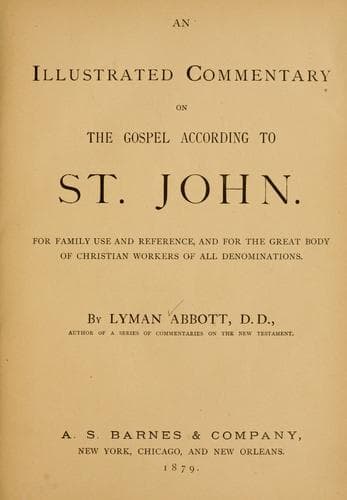
An illustrated commentary on the Gospel according to St. JohnAbbott, Lyman
Religion
An illustrated commentary on the Gospel according to St. John
Abbott, Lyman
Bible. John -- Commentaries
language _out of his belly_ clearly implies something received that it
may flow _from_ the recipient unto others. The water which he drinks
becomes in him a spring from which living waters flow, as the light
which illuminates him makes him in turn one of the lights which
illuminate the world (Matt. 5:14; Phil. 2:15). That this is the
meaning is clear, not only from the language here, but from John’s
interpretation in the succeeding verse. “The mutual and inspired
intercourse of Christians from Pentecost downwards, the speaking in
psalms and hymns and spiritual songs, the mutual edification in
Christian assemblies by means of the charismata even to the speaking
with tongues, the entire work of the apostles, of a Stephen and so on,
furnish an abundant historical commentary upon this text.”--(_Meyer._)
39 (But this spake he of the[293] Spirit, which they that
believe on him should receive: for the Holy Ghost was not
yet _given_; because that Jesus was not yet glorified.)
[293] ch. 16:7; Isa. 44:3; Joel 2:28; Acts 2:17, 33.
=39. But this spake he of the Spirit.= This declaration of John makes
the second chapter of Acts and the succeeding history of the Church of
Christ the true commentary on Christ’s promise.--=For the Spirit was
not yet.= The meaning cannot of course be that the Holy Spirit had no
existence, for “this would be not only in flat contradiction to chaps.
1:32, 33; 3:5, 8, 34, but to the whole O. T., in which the agency of
the Spirit in the _outward world_ is recognized even more vividly than
in the N. T.” (_Alford._) And it is not only in the outward world that
the O. T. recognizes the Holy Spirit, but also in the hearts of
individual prophets, who thus became the ministers of divine grace to
others (Gen. 41:38; Exod. 4:11, 12; 31:3; 2 Chron. 15:1; Ps. 51:11;
Isa. 63:11, 14). Nor does the addition by the translators of the word
_given_ adequately represent the meaning, for the Holy Ghost was given
before the glorification of Christ, but not to all men; he was not a
universal gift. The meaning is that the dispensation of the Holy Ghost
had not yet begun; he had not yet been so given that whoever had faith
in the Son of God received the gift of the Holy Ghost and became one
of the Lord’s prophets (Acts 2:38). See Acts 2:4, note.--=Because
Jesus was not yet glorified.= The death and resurrection of Christ
were the conditions precedent of the outpouring of the Holy Ghost (ch.
14:16, 17; 16:7; Acts 1:7-9).
40 Many of the people therefore, when they heard this
saying, said, Of a truth this is the Prophet.[294]
[294] ch. 6:14; Deut. 18:15, 18.
41 Others said, This is the[295] Christ. But some said,
Shall[296] Christ come out of Galilee?
[295] chaps. 4:42, 6:69.
[296] verse 52; ch. 1:46.
42 Hath not the scripture said, That Christ[297] cometh of
the seed of David, and out of the town of Bethlehem,[298]
where David[299] was?
Public-domain text, read in full here on John Shaqi.
Reviews
Reviews
No reviews yet
Be the first to share your thoughts on this work.
Elsewhere in the archive
Join the Discussion
Join the discussion
Sign in to leave a comment or review.
Sign InorCreate an account