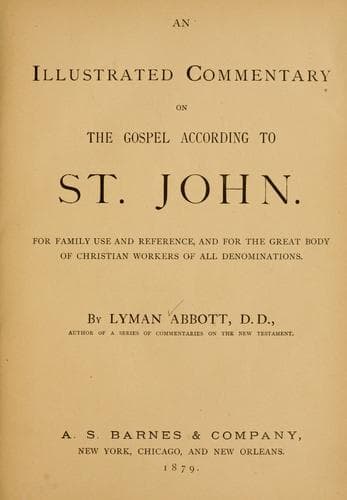
An illustrated commentary on the Gospel according to St. JohnAbbott, Lyman
Religion
An illustrated commentary on the Gospel according to St. John
Abbott, Lyman
Bible. John -- Commentaries
are free when we perfectly comprehend the laws of nature, _i. e._, of
God, perfectly and cheerfully comply with them, and so know how to get
the advantage and profit of them. All progress in material
civilization has been attained by increasing knowledge of the divine
laws, and consequently an increased use of them. We have yet to learn
the gain that there is in a similar comprehension of and obedience to
the intellectual and the spiritual laws of the universe. Thus it is
that the _truth_ makes _free_ (ver. 32).
37 I know that ye are Abraham’s seed: but ye seek to kill
me, because my word hath no place in you.
38 I[338] speak that which I have seen with my Father: and
ye do that which ye have seen with your father.
[338] ch. 14:10, 24.
=37, 38. I know that ye are Abraham’s seed.= Not equivalent to _I
know that ye regard yourselves as Abraham’s seed_. The reference is
to the covenant with Abraham (Gen. 12:1-3; 17:4-8), which
involved a promise of divine protection and blessing to the nation. The
Pharisees adhere to the idea of political freedom. Christ assents to
their declaration that they are the seed referred to in that covenant,
but returns to the spiritual idea which underlies his discourse, and
emphasizes the extent to which, in character, they have wandered from
the pattern set by Abraham.--=Nevertheless= (ἀλλὰ, notwithstanding you
are Abraham’s seed) =ye seek to kill me= (chaps. 7:1, 19, 32; 8:59;
10:31, 39). To whom were these words spoken?--to the believing
Judeans mentioned in ver. 30, or to enemies? The true answer is that
believers and unbelievers were intermixed in the crowd, and that it
is as little possible for the reader now as it would have been for
the observer then to distinguish between them.--=Because my word
makes no progress in you.= They heard it--nay, crowded round him to
hear it, were willing and interested listeners. But the truth did not
get entrance into their hearts, nor permeate their character. It was
not like the leaven hid in three measures of meal. They were thus a
type of many modern hearers who listen to the truth, but in whom the
truth does not work. The words rendered _hath no place_ (οὐ χωρεῖ)
signify, literally, does not _work, spread, go forward_.--=I do that
which I have seen with my Father, and ye do that which ye have heard
with your father= (ἠκούσατε, _heard_, not ἑωράκατε, _seen_, is the
better reading). Christ approaches a truth whose depths, in our
ignorance of the spirit world, we cannot sound. This is that every
soul draws its inspiration from an invisible world--either belongs to
the kingdom of light and is taught of God, or belongs to the kingdom
of darkness and is taught of evil spirits. The unseen companions of
the soul are the most influential. Demoniacal possession is only an
exceptional fruitage of a universal demoniacal inspiration. See below,
on ver. 44.
Public-domain text, read in full here on John Shaqi.
Reviews
Reviews
No reviews yet
Be the first to share your thoughts on this work.
Elsewhere in the archive
Join the Discussion
Join the discussion
Sign in to leave a comment or review.
Sign InorCreate an account