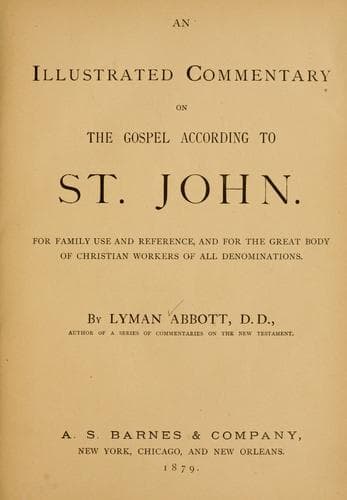
An illustrated commentary on the Gospel according to St. JohnAbbott, Lyman
Religion
An illustrated commentary on the Gospel according to St. John
Abbott, Lyman
Bible. John -- Commentaries
=57-59. The Judeans therefore said to him, Thou art not yet fifty years
old.= No indication of his actual age. The fifty years was specified
because this was the age of a perfected maturity, according to Jewish
notions (Numb. 4:3, 39; 8:24--Lightfoot).--=And hast thou seen
Abraham?= He did not say that he had, but that Abraham had seen him.
They pervert his words, partly through stupidity, partly through
wilfulness.--=Verily, verily.= The precursor of a specially solemn
declaration.--=Before Abraham was born, I am= (γίγνομαι-εἰμί). Two
Socinian explanations are afforded of this passage: (1) Before Abraham
was born I (Christ) existed in the divine counsels, _i. e._ I was
purposed by God and foretold by him; (2) Before Abram can become
Abraham, a spiritual father of nations, I (Christ) must be sent forth
as the Messiah. They both seem to me to be shifts devised to
accommodate Scripture to a theological preconception. All independent
Greek scholars (Meyer, Luthardt, Alford, Godet, Tholuck, etc.) agree
substantially in their interpretation of the language. Its meaning is
made clear by a consideration of the original Greek, in which the
contrast is strongly marked between Abraham, who began to be, and
Christ, who eternally is; by the context, in which the pre-eminence of
Christ above Abraham is clearly implied; by the unexpressed but hardly
doubtful reference to the appellation given by the O. T. to Jehovah as
the I AM (Exod. 3:14; comp. Matt. 14:27; Mark 6:50; 14:62; John 8:24,
25); and by the interpretation which was put upon Christ’s words by
his auditors, who understood them as a claim of divinity, and took up
stones to stone him as a blasphemer. Christ, then, by these words, as
I understand him, identifies himself, as the N. T. manifestation of
the unseen God, with the I AM of the O. T., the One who had manifested
the Invisible to Israel in all their history.--=Then took they up
stones to cast at him.= The building of the temple was still going on,
and stones were probably lying about in the temple court. Stoning was
the O. T. punishment for blasphemy, but it could not be lawfully
inflicted without trial and judgment.--=Jesus hid himself.= There is
no good ground to suppose any miraculous escape, either here or in
Luke 4:30. And there is good reason to believe that there was not a
miraculous interposition, for Christ never availed himself of any
miracle for his own benefit. See Matt. 4:6, note. The clause “going
through the midst of them, and so passed by,” is wanting in the best
MSS., and is omitted by Alford, Meyer, Godet, Luthardt. The latter
traces a curious analogy between this typical expulsion and the final
crucifixion of Christ. He hides himself from the eyes of those whom
the God of this world has blinded; he leaves the Pharisees apparent
victors and in possession of the field; in taking up stones to stone
him they show themselves to be murderers at heart, as they afterward
became in outward act.
Public-domain text, read in full here on John Shaqi.
Reviews
Reviews
No reviews yet
Be the first to share your thoughts on this work.
Elsewhere in the archive
Join the Discussion
Join the discussion
Sign in to leave a comment or review.
Sign InorCreate an account