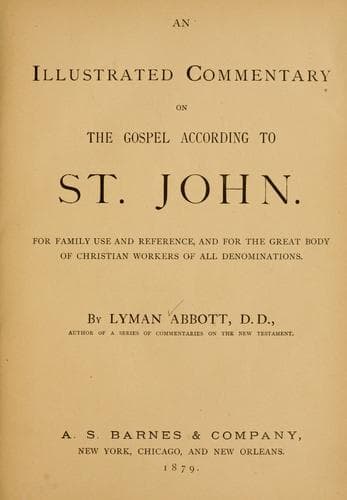
An illustrated commentary on the Gospel according to St. JohnAbbott, Lyman
Religion
An illustrated commentary on the Gospel according to St. John
Abbott, Lyman
Bible. John -- Commentaries
=2. He that entereth in by the door the same is a shepherd of the
sheep.= Not, as in our English version, _the_ shepherd. The definite
article is wanting. Christ does not declare that the evidence that he
is the Shepherd consists in the fact that he entered through the door,
for he is himself the door. He declares to the Pharisees, who reject
him as their Messiah, that there is a double test of the religious
teacher: (1) he must enter into the church by the way by which
he directs the sheep to enter. There is not one salvation for the
teacher and another for the taught; the door is the same to all; and
(2) he must enter by the one only door, Jesus Christ. Whoever comes in
the name and with the authority of Jesus Christ is a shepherd of the
sheep; whoever comes to preach any other Gospel, comes to rob the sheep
of their Saviour and salvation (Gal. 1:8, 9; 2 John, ver. 10).
3 To him[390] the porter openeth; and the sheep hear his
voice: and he calleth[391] his own sheep by name and
leadeth[392] them out.
[390] Rev. 3:20.
[391] Ezek. 34:11; Rom. 8: 30.
[392] Isa. 40:11.
=3. To him the porter openeth.= “The Holy Spirit is especially He
who opens the door to the shepherds; see frequent uses of this
symbolism by the apostles (Acts 14:27; 1 Cor. 16:9; 2 Cor. 2:12;
Col. 4:3); and instances of the porter shutting the door (Acts
16:6, 7).”--(_Alford._) There is the implication here of a truth
elsewhere abundantly taught in Scripture, that the teacher has access
to the heart of the church only through the influence of the Spirit of
God, who opens and closes the heart of the hearer (1 Thess. 1:5;
2:1), and the door of opportunity (Acts 4:7, 8; 16:9; 17:10,
11).--=And he calleth his own sheep by name and leadeth them out.=
This figure exactly corresponds with the actual facts of shepherd life
in the East. “As we eat and looked, almost spell-bound, the silent
hillsides around us were in a moment filled with life and sound. The
shepherds led their flocks forth from the gates of the city. They were
in full view, and we watched them and listened to them with no little
interest. Thousands of sheep and goats were there, grouped in dense,
confused masses. The shepherds stood together until all came out. Then
they separated, each shepherd taking a different path, and uttering, as
he advanced, a shrill, peculiar call. The sheep heard them. At first
the masses swayed and moved, as if shaken by some internal convulsion;
then points struck out in the direction taken by the shepherds; these
became longer and longer, until the confused masses were resolved into
long, living streams, flowing after their leaders. Such a sight was not
new to me, still it had lost none of its interest. It was, perhaps, one
of the most vivid illustrations which human eyes could witness of that
beautiful discourse of our Lord recorded by John.”--(_Porter._)
Public-domain text, read in full here on John Shaqi.
Reviews
Reviews
No reviews yet
Be the first to share your thoughts on this work.
Elsewhere in the archive
Join the Discussion
Join the discussion
Sign in to leave a comment or review.
Sign InorCreate an account