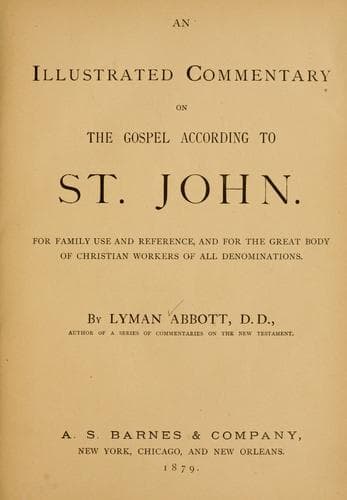
An illustrated commentary on the Gospel according to St. JohnAbbott, Lyman
Religion
An illustrated commentary on the Gospel according to St. John
Abbott, Lyman
Bible. John -- Commentaries
=8. All whosoever came before me are thieves and robbers.= This verse
is declared by Tholuck to be “one of the most difficult sentences in
the N. T.” If _before_ (πρό) be taken as an adverb of time, as is
generally done, then Christ’s declaration is that all religious
teachers who preceded him were thieves and robbers, and this would on
its face include the long line of prophets from Moses to Malachi; or
if the sentence is modified, as some propose, by the fact that the
verb is in the present tense, _are_ thieves and robbers, so that
Christ embraces only the then living teachers, still this would
include such instructors as Gamaliel and Nicodemus, if not John the
Baptist, who belonged to that generation. The qualification of this,
by the supposition that Christ did not include true teachers but only
the false, not only falsifies his declaration which points out the way
in which the true may be distinguished from the false, but reduces the
sentence to a truism, viz., All false religious teachers who came
before me, are thieves and robbers, _i. e._, teachers of falsehood,
depriving men of the truth. The other proposed qualification, All who
have come claiming to be Messiah, are thieves, etc., not only adds an
important qualification to Christ’s declaration, but is historically
an anachronism, inasmuch as there is no historical evidence that any
false Messiah preceded the time of Christ. I am inclined, therefore,
to take _before_ (πρό) as an adverb signifying precedence in rank or
authority, as it does in Col. 1:17, James 5:12, and 1 Pet. 4:8, and to
understand the passage, _All whosoever come claiming precedence above
me are thieves and robbers_. The verb _come_ (ἦλθον) is in the aorist
tense, and does not necessarily indicate a coming in the past only,
but would be properly used for the enunciation of a general principle.
The prophets of the O. T. claimed no such precedence above Christ; on
the contrary, they were but his heralds; and John the Baptist
distinctly disavowed such precedence (Matt. 3:14; chaps. 1:26, 27;
3:30). The Pharisees, on the other hand, denied Christ’s right to
teach, because he did not belong to their schools (ch. 7:15), and in
their conference with the blind man had put themselves above Christ
(ch. 9:16, 24). Where there is no general agreement among scholars, I
hesitate to offer an interpretation which differs from all, but this
appears to me on the whole more consistent with the context, and with
the teaching of the N. T. elsewhere, than any other, and not
inconsistent with the original. If this be a correct interpretation,
Christ’s claim here is directly antagonistic to those who would make
an eclectic religion, by selecting truth from all the world’s
religious teachers, including Christ among the rest. For he declares
all to be robbing the world of truth, not imparting it, who deny him
the pre-eminent rank as a religious teacher. On the other hand, he
does not stigmatize genuine moral teachers, such as Buddha or
Public-domain text, read in full here on John Shaqi.
Reviews
Reviews
No reviews yet
Be the first to share your thoughts on this work.
Elsewhere in the archive
Join the Discussion
Join the discussion
Sign in to leave a comment or review.
Sign InorCreate an account