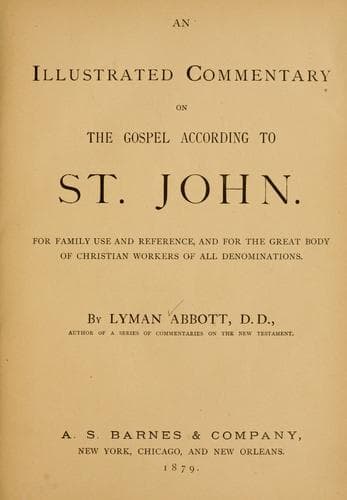
An illustrated commentary on the Gospel according to St. JohnAbbott, Lyman
Religion
An illustrated commentary on the Gospel according to St. John
Abbott, Lyman
Bible. John -- Commentaries
=11, 12.= With these verses Christ gives a new direction to the
preceding parable. He has thus far spoken of religious teachers
in general, and of himself as the _door_ by which they alone can
enter in to feed the flock, and by which alone the flock can enter
in to find safety. He now speaks of himself as the Great Shepherd
and Bishop of souls (1 Pet. 2:25), under whom are all the shepherds,
and in contrast with whom are the hirelings.--=I am the Good
Shepherd=, more literally the _beautiful_ Shepherd; but this word
(καλός), though strictly speaking esthetic, was used by the Greeks to
designate moral beauty, and referred to the most symmetrical and
perfect goodness. Throughout the O. T. the church of God is regarded
as a fold, Israel as a flock, and Jehovah himself as the Shepherd (Ps.
23; Isa. 40:11; Ezek., ch. 34; Jer., ch. 23; Micah 5:3; Zech., ch.
11). It is impossible but that Christ’s auditors should have
understood him as claiming to be this Shepherd of Israel. Observe the
difference between the phraseology here and in verse 2; here _the_
good Shepherd; there _a_ Shepherd.--=The good shepherd layeth down his
life for the sheep.= This is not a prophecy, equivalent to, I am about
to die for my sheep; it is the enunciation of a general principle by
which every good shepherd can be distinguished from the hireling; for
every good shepherd is ready to sacrifice his life for his sheep
because they are his; the hireling flees when danger threatens,
because he is an hireling and has no real interest in the sheep.
Neither is the expression _to lay down the life_ a circumlocution for
_die_. Christ rarely uses circumlocution of any kind. The good
shepherd may or may not be called on to die for his sheep; but he
always lays down his life for them. To lay down the life is to
consecrate it, devote it to the flock; as a mother, who is always
ready to die for her children, but who, living or dying, belongs to
her children and surrenders herself to them. So we ought also to lay
down our lives for the brethren (1 John 3:16), though comparatively
few are ever called on to die for them. Wickliffe and Luther as truly
laid down their lives for the flock as Huss and Tyndale. The sacrifice
of Christ consisted not merely in his death--which was indeed in its
mere physical aspects the least part of it--but in his whole
incarnation. His entire life from his advent to the grave was laid
down for his sheep. This laying down of his life includes his death;
but it includes much more. The whole thirty years was a living
sacrifice for sinful humanity (Phil. 2:5-8).--=But he that is an
hireling, not being a shepherd, whose own the sheep are not, seeth the
wolf coming, and leaveth the sheep and fleeth.= Every clause in this
sentence must be carefully weighed by the student; for every clause is
full of weighty significance. There is nothing in the sentence, if the
whole be considered, adverse to a paid ministry. Not every one who is
hired is an hireling (1 Tim.
Public-domain text, read in full here on John Shaqi.
Reviews
Reviews
No reviews yet
Be the first to share your thoughts on this work.
Elsewhere in the archive
Join the Discussion
Join the discussion
Sign in to leave a comment or review.
Sign InorCreate an account