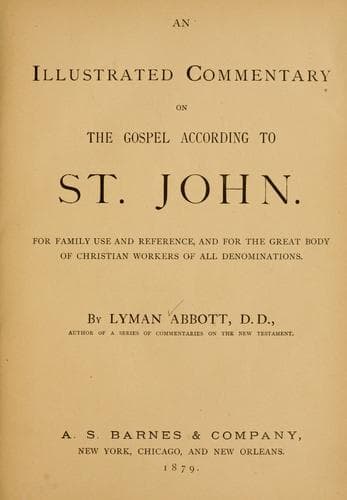
An illustrated commentary on the Gospel according to St. JohnAbbott, Lyman
Religion
An illustrated commentary on the Gospel according to St. John
Abbott, Lyman
Bible. John -- Commentaries
=13-15. The hireling * * * careth not for the sheep * * *=--=I know my
sheep.= Christ reiterates the contrast between the hireling and the
good shepherd; and indicates anew points of distinction between the
two. The hireling careth not for the sheep; he cares only for his
wages; the good shepherd knows his sheep and is known by them. In a
limited way this is true of the good pastor or shepherd; he knows his
flock personally and sympathizingly; he is not merely a preacher to
them; he is their best friend and adviser (ver. 3, note). But this
knowledge is never perfect, and never can be, in the under shepherd.
His insight is imperfect; his sympathy is partial. It is only Christ
who can say I _know_ my sheep. “If you would think rightly of the Son
of Man, think of the Person who knows thoroughly everything that each
one of you is feeling, and cannot utter to others or to himself--every
temptation from riches, from poverty, from solicitude, from society,
from gifts of intellect, from the want of them, from the gladness of
the spirit, from the barrenness and dreariness of it, from the warmth
of affection and from the drying up of affection, from the anguish of
doubt and the dulness of indifference, from the whirlwind of passion
and the calm which succeeds it, from the vile thoughts which spring
out of fleshly appetites and indulgences, from the darker, more
terrible suggestions which are presented to the inner will. Believe
that he knows all these, that he knows _you_. And then believe this
also, that all he knows is through intense, inmost sympathy, not with
the evil that is assaulting you, but with you who are assaulted by it.
Believe that knowledge, in this the Scriptural sense of it--the human
as well as the divine sense of it--is absolutely inseparable from
sympathy.”--(_Maurice._)--=And am known of mine.= Christ’s knowledge
of the Christian is the basis of the Christian’s knowledge of Christ.
Both are sympathetic and personal, the knowledge of love. It is
because the Good Shepherd knows his sheep that he is known of them. It
is because by his knowledge he is able to enter into our innermost
experience, and to give us comfort and strength when all human helpers
fail, that we come to know him as our Helper and our Strength. We know
him as the Good Shepherd only as we follow his guidance, accept the
food and water he gives us, are restored by him when wandering, and
delivered by him from danger and death.--=As the Father knoweth me,
even so know I the Father; and I lay down my life for the sheep.= The
connection is not very clear between this sentence and the preceding
one, or between the different clauses of this sentence. It seems to
me, however, that Christ refers to this knowledge between himself and
the Father, not merely to illustrate the knowledge between himself and
his disciples, but to turn their thoughts from himself to the Father.
Christ has been accused of blasphemy by the Jews; that is, of
Public-domain text, read in full here on John Shaqi.
Reviews
Reviews
No reviews yet
Be the first to share your thoughts on this work.
Elsewhere in the archive
Join the Discussion
Join the discussion
Sign in to leave a comment or review.
Sign InorCreate an account