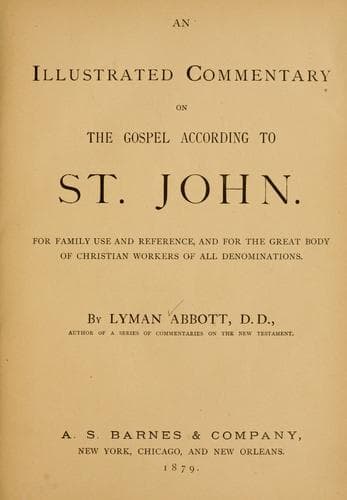
An illustrated commentary on the Gospel according to St. JohnAbbott, Lyman
Religion
An illustrated commentary on the Gospel according to St. John
Abbott, Lyman
Bible. John -- Commentaries
Ch. 1:19-51. INTRODUCTION OF CHRIST TO THE WORLD. BY JOHN THE BAPTIST
(vers. 19-37); BY HIMSELF (vers. 38-51). CHRIST THE SIN-BEARER OF THE
WORLD.--THE POWER OF CHRIST; THE ABIDING OF GOD’S SPIRIT ON HIM.--
CHRIST OUR PATTERN IN FISHING FOR MEN.--THE VALUE OF PERSONAL AND
PRIVATE WORK.--THE POWER OF PREJUDICE IN GOOD MEN.--THE BEST ANSWER TO
SKEPTICISM, “COME AND SEE.”--CHRIST REVEALS HIMSELF WHEN HE REVEALS US
TO OURSELVES.--CHRIST’S FIRST COMING A PROPHECY AND FORETASTE OF HIS
SECOND COMING.
The historical portion of the Fourth Gospel begins here. The interview
between the deputation from the Sanhedrim and John the Baptist here
described probably took place after the baptism of Jesus, and during
the temptation, of which latter event this Gospel makes no mention.
With the account of the Baptist’s ministry given here the reader
should compare Matt., chap. 3, and Luke, chap. 3.
19 And this[48] is the record of John, when the Jews sent
priests and Levites from Jerusalem to ask him, Who art
thou?
[48] Luke 3:15, etc.
20 And he confessed, and denied not; but confessed, I am
not the Christ.
=19, 20. And this is the witness of John.= The writer goes back and
gives a detailed history of John’s first explicit testimony to the
Messiah, connecting it with his previous reference to that testimony in
verse 15.--=When the Jews sent priests and Levites.= In John’s Gospel,
the term Jews generally signifies, not the residents of Palestine,
but those of Judea, and sometimes the official heads of the people.
This appears to be the meaning here. It is clear from verse 22 that
this was an official deputation, probably sent by the Sanhedrim. The
Baptist’s preaching had produced a profound sensation throughout
that part of Palestine; great crowds flocked to his ministry; he
was universally regarded as a prophet, and by some as perhaps the
Messiah; some of the Pharisees themselves came to his baptism, though
his severe denunciation of their formalism, and their own opposition
to such a personal reform as his preaching demanded, made them, as
a class, bitterly opposed to him (Matt. 3:5, 7; 21:25, 26; Luke
3:15). It was therefore natural and fit that the Sanhedrim should
send to inquire officially respecting his ministry. There is nothing
to indicate whether this inquiry was conducted in a hostile spirit or
otherwise.--=Who art thou?= Observe, throughout this interview, the
difference in the spirit of the inquirers and of John. They persist in
demanding to know _who_ he is; he replies only by pointing out _what_
he does. “They ever ask about his _person_; he ever refers them to his
_office_. He is no one--a _voice_ merely; it is the work of God, the
testimony to Christ, which is everything. So the formalist ever in the
church asks, _Who_ is he? while the witness for Christ only exalts,
only cares for Christ’s work.”--(_Alford._)--=And he publicly
acknowledged, and denied not.= We know from Luke 3:15 that some
Public-domain text, read in full here on John Shaqi.
Reviews
Reviews
No reviews yet
Be the first to share your thoughts on this work.
Elsewhere in the archive
Join the Discussion
Join the discussion
Sign in to leave a comment or review.
Sign InorCreate an account