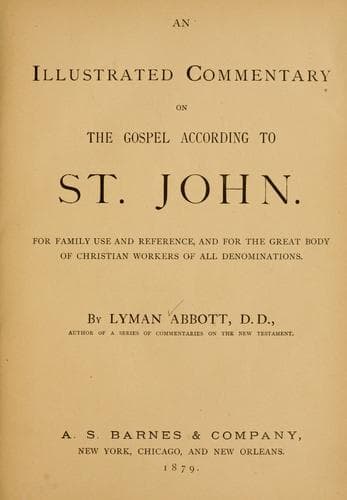
An illustrated commentary on the Gospel according to St. JohnAbbott, Lyman
Religion
An illustrated commentary on the Gospel according to St. John
Abbott, Lyman
Bible. John -- Commentaries
=11, 12. We speak that we do know=, etc. Christ has spoken hitherto
only of that which is matter of common observation, viz., man’s need
of a new and divine life, and the apparent results of it in character
and conduct. He now speaks of that which is matter of personal
experience with Him, the new life in the soul. He now becomes not
merely an interpreter to facts that are patent, but also a _witness_
to facts that are not. Christian teaching, to be effectual, must
always be founded on personal experience of the truth taught (1 Cor.
2:12, 13).--=Earthly things ... heavenly things.= The connection of
these verses with the preceding interprets the contrast which Christ
here indicates. Nicodemus has impliedly asked for an exposition of
Christ’s system of truth. Christ has replied by saying that no man can
understand the truths that pertain to the kingdom of God unless he is
born again. This necessity of a radical change in heart and life in
order to appreciate divine things is an earthly fact, easily tested by
an observation of men; a striking evidence of it is afforded by the
question of Nicodemus in verse 4. He then immediately goes on to ask
how such a change can be effected. But this, the method of God’s work
in anew creating the heart, is a heavenly thing, not a matter of
observation; and Christ says, If you do not believe me when I tell you
a truth which you can easily verify by studying the earthly life of
men, what use is there in my telling you the secrets of God’s working,
the truth of which disclosure you have no means of verifying. Observe
the implication that the things which are earthly, literally, _upon
the earth_ (ἐπίγεία), belong to us to study and know, and the things
which are heavenly, literally, which take place _in the_ heavens
(ἐπουρανια), belong to the secret counsels and work of God, and do not
belong to us to investigate (Deut. 29:29). And yet by far the largest
proportion of theological conflicts have taken place respecting these
hidden things, concerning God’s eternal counsels not man’s present
duty.
13 And[94] no man hath ascended up to heaven, but he that
came down from heaven, _even_ the Son of man which is in
heaven.
[94] Eph. 4:9, 10.
Public-domain text, read in full here on John Shaqi.
Reviews
Reviews
No reviews yet
Be the first to share your thoughts on this work.
Elsewhere in the archive
Join the Discussion
Join the discussion
Sign in to leave a comment or review.
Sign InorCreate an account