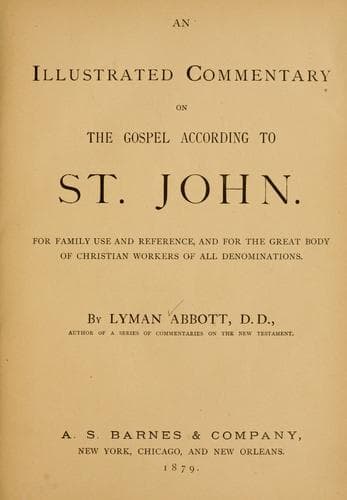
An illustrated commentary on the Gospel according to St. JohnAbbott, Lyman
Religion
An illustrated commentary on the Gospel according to St. John
Abbott, Lyman
Bible. John -- Commentaries
=19. And this is the condemnation.= Not merely, This is the cause of
the condemnation; Christ has already stated that in the preceding
verse; he here states the nature of the condemnation. He that loves
darkness rather than light is given over to his own choice; this is
the sentence pronounced against him (Hosea 4:1-17; Rom. 1:28; Rev.
22:11).--=Men loved darkness rather than light.= Not merely _more_
than light; they chose darkness. For illustration of this deliberate
choice of darkness see Matt. 13:14, 15; 28:12-14; John 6:66; 12:10,
11; Acts 4:16, 17; 2 Tim. 4:10. This is not always, however, a
conscious and deliberate choice. See John 12:43; 2 Tim. 3:4.--=Because
their deeds are evil.= _Corrupting to others._ This is the force of
the Greek word (πονηρὰ), which is different from that rendered _evil_
in the next verse. The corrupting power of sin lies in its secreting
its evil character and purpose; hence it avoids the light; hence too
it is called in Scripture the power of darkness (Luke 22:53; Col.
1:13; Rev. 16:10). Observe the secret cause of unbelief here
indicated; men are willfully ignorant of the truth. It is not the
intellect, but the will which is perverse. “The source of unbelief is
immorality.”--(_Meyer._)
20 For every one that doeth evil hateth the light,
neither[101] cometh to the light, lest his deeds should be
reproved.
[101] Job 24:13, 17; Pr. 4:18, 19.
=20. Every one that practiseth evil.= _Worthless things_ (φαῦλα) not
as in the preceding verse, _things corrupting_. But corrupting include
worthless things, for they are not only worthless but worse than
worthless. The evil here characterized is parallel to the idle words of
Matt. 12:36, and it is opposed to the truth which is always fruitful in
goodness and love.--=Hateth the light.= It has been supposed by some
that there is in these words a covert rebuke of Nicodemus for coming to
Christ secretly by night. This seems to me improbable. Christ was not
accustomed to conceal his rebukes so deftly.--=Lest his deeds should be
reproved.= Not necessarily by words of condemnation, but by the mere
exposure of their worthlessness when brought to the light. See Luke
3:19, 20; John 8:8, 9; Compare Ephes. 5:11-13.
21 But he that doeth[102] truth cometh to the light, that
his deeds may be made manifest, that they are wrought[103]
in God.
[102] 1 John 1:6.
[103] John 3:21.
Public-domain text, read in full here on John Shaqi.
Reviews
Reviews
No reviews yet
Be the first to share your thoughts on this work.
Elsewhere in the archive
Join the Discussion
Join the discussion
Sign in to leave a comment or review.
Sign InorCreate an account