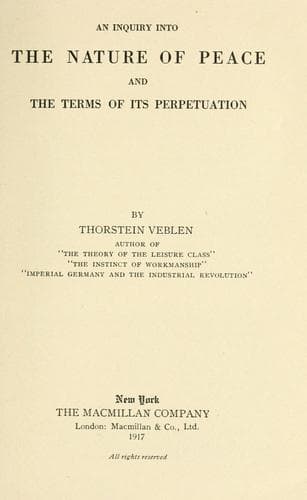
An Inquiry into the Nature of Peace and the Terms of Its PerpetuationVeblen, Thorstein
Philosophy
An Inquiry into the Nature of Peace and the Terms of Its Perpetuation
Veblen, Thorstein
Peace; World War, 1914-1918 -- Peace
It will be evident from beforehand that the grave difficulty to be met
in any advocacy of peace on terms of non-resistant subjection to an
alien dynastic rule--"peace at any price"--is a difficulty of the
psychological order. Whatever may be conceived to hold true for the
Chinese people, such submission is repugnant to the sentiments of the
Western peoples. Which in turn evidently is due to the prevalence of
certain habitual preconceptions among modern civilised men,--certain
acquired traits of temper and bias, of the nature of fixed ideas. That
something in the way of a reasonably contented and useful life is
possible under such a regime as is held in prospect, and even some
tolerable degree of well-being, is made evident in the Chinese case. But
the Chinese tolerance of such a regime goes to argue that they are
charged with fewer preconceptions at variance with the exigencies of
life under these conditions. So, it is commonly accepted, and presumably
to be accepted, that the Chinese people at large have little if any
effectual sense of nationality; their patriotism appears to be nearly a
negligible quantity. This would appear to an outsider to have been their
besetting weakness, to which their successful subjection by various and
sundry ambitious aliens has been due. But it appears also to have been
the infirmity by grace of which this people have been obliged to learn
the ways of submission, and so have had the fortune to outlive their
alien masters, all and sundry, and to occupy the land and save the
uncontaminated integrity of their long-lived civilisation.
* * * * *
Some account of the nature and uses of this spirit of patriotism that is
held of so great account among Western nations has already been set out
in an earlier passage. One or two points in the case, that bear on the
argument here, may profitably be recalled. The patriotic spirit, or the
tie of nationalism, is evidently of the nature of habit, whatever
proclivity to the formation of such a habit may be native to mankind.
More particularly is it a matter of habit--it might even be called a
matter of fortuitous habit--what particular national establishment a
given human subject will become attached to on reaching what is called
"years of discretion" and so becoming a patriotic citizen.
Public-domain text, read in full here on John Shaqi.
Reviews
Reviews
No reviews yet
Be the first to share your thoughts on this work.
Elsewhere in the archive
Join the Discussion
Join the discussion
Sign in to leave a comment or review.
Sign InorCreate an account