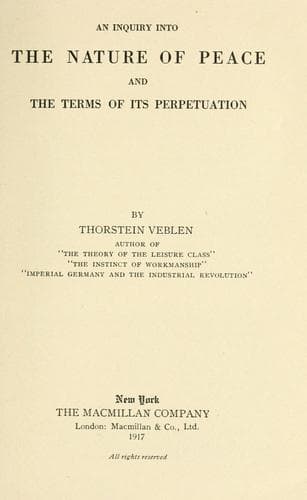
An Inquiry into the Nature of Peace and the Terms of Its PerpetuationVeblen, Thorstein
Philosophy
An Inquiry into the Nature of Peace and the Terms of Its Perpetuation
Veblen, Thorstein
Peace; World War, 1914-1918 -- Peace
The change of habituation necessary to bring about such a decay of the
bellicose national spirit would appear to be of a negative order, at
least in the main. It would be an habituation to unconditional peace and
security; in other words, to the absence of provocation, rather than a
coercive training away from the bellicose temper. This bellicose temper,
as it affects men collectively, appears to be an acquired trait; and it
should logically disappear in time in the absence of those conditions by
impact of which it has been acquired. Such obsolescence of patriotism,
however, would not therefore come about abruptly or swiftly, since the
patriotic spirit has by past use and wont, and by past indoctrination,
been so thoroughly worked into the texture of the institutional fabric
and into the commonsense taste and morality, that its effectual
obsolescence will involve a somewhat comprehensive displacement and
mutation throughout the range of institutions and popular conceits that
have been handed down. And institutional changes take time, being
creations of habit. Yet, again, there is the qualification to this last,
that since the change in question appears to be a matter, not of
acquiring a habit and confirming it in the shape of an article of
general use and wont, but of forgetting what once was learned, the time
and experience to be allowed for its decay need logically not equal that
required for its acquirement, either in point of duration or in point of
the strictness of discipline necessary to inculcate it.
While the spirit of nationalism is such an acquired trait, and while it
should therefore follow that the chief agency in divesting men of it
must be disuse of the discipline out of which it has arisen, yet a
positive, and even something of a drastic discipline to the contrary
effect need not be altogether ineffectual in bringing about its
obsolescence. The case of the Chinese people seems to argue something of
the sort. Not that the Chinese are simply and neutrally unpatriotic;
they appear also to be well charged with disloyalty to their alien
rulers. But along with a sense of being on the defensive in their common
concerns, there is also the fact that they appear not to be appreciably
patriotic in the proper sense; they are not greatly moved by a spirit
of nationality. And this failure of the national spirit among them can
scarcely be set down to a neutral disuse of that discipline which has on
the other hand induced a militant nationalism in the peoples of
Christendom; it should seem more probable, at least, that this relative
absence of a national ambition is traceable in good part to its having
been positively bred out of them by the stern repression of all such
aspirations under the autocratic rule of their alien masters.
* * * * *
Public-domain text, read in full here on John Shaqi.
Reviews
Reviews
No reviews yet
Be the first to share your thoughts on this work.
Elsewhere in the archive
Join the Discussion
Join the discussion
Sign in to leave a comment or review.
Sign InorCreate an account