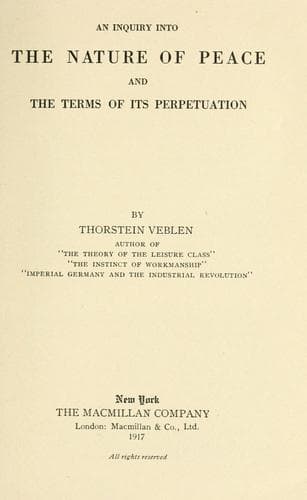
An Inquiry into the Nature of Peace and the Terms of Its PerpetuationVeblen, Thorstein
Philosophy
An Inquiry into the Nature of Peace and the Terms of Its Perpetuation
Veblen, Thorstein
Peace; World War, 1914-1918 -- Peace
It is usual to notice, and not unusual to deplore the duplication of
plant and appliances in many lines of industry, due to competitive
management, as in factories engaged in the same class of manufacture, in
parallel or otherwise competing railways and boat lines, in retail
merchandising, and in some degree also in the wholesale trade. The
result, of course, is sabotage; in the sense that this volume of
appliances, materials and workmen are not employed to the best advantage
for the community. One effect of the arrangement is an increased
necessary cost of the goods and services supplied by these means. The
reason for it is competition for gain to be got from the traffic. That
all this is an untoward state of things is recognised on all hands; but
no lively regret is commonly spent on the matter, since it is commonly
recognised that under the circumstances there is no help for it except
at the cost of a more untoward remedy.
The competitive system having been tried and found good--or at least so
it is assumed--it is felt that the system will have to be accepted with
the defects of its qualities. Its characteristic qualities are held to
be good, acceptable to the tastes of modern men whose habits of thought
have been standardised in its terms; and it would be only reluctantly
and by tardy concession that these modern men could bring themselves to
give up that scheme of "Natural Liberty" within the framework of which
runs this competitive system of business management and its wasteful
manifolding of half-idle equipment and nugatory work. The common man, at
the worst, comforts himself and his neighbour with the sage reflection
that "It might have been worse." The businessmen, on the other hand,
have also begun to take note of this systematic waste by duplication
and consequent incompetence, and have taken counsel how to intercept the
waste and divert it to their own profit. The businessmen's remedy is
consolidation of competing concerns, and monopoly control.
To the common man, with his preconceptions on the head of "restraint of
trade," the proposed remedy seems more vicious than the evil it is
designed to cure. The fault of the remedy plainly is not that the
mismanagement of affairs due to competitive business can not be
corrected by recourse to monopoly, but only that the community, it is
presumed, would still suffer all the burdens and discomforts of the
regime of competition and sabotage, with, possibly, further
inconveniences and impositions at the hands of the businesslike
monopoly; which, men are agreed, may fairly be depended on to use its
advantage unsparingly under the business principle of charging what the
traffic will bear.
Public-domain text, read in full here on John Shaqi.
Reviews
Reviews
No reviews yet
Be the first to share your thoughts on this work.
Elsewhere in the archive
Join the Discussion
Join the discussion
Sign in to leave a comment or review.
Sign InorCreate an account