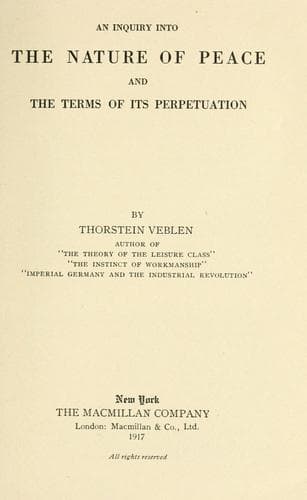
An Inquiry into the Nature of Peace and the Terms of Its PerpetuationVeblen, Thorstein
Philosophy
An Inquiry into the Nature of Peace and the Terms of Its Perpetuation
Veblen, Thorstein
Peace; World War, 1914-1918 -- Peace
These dynastic States among the rest have partly followed the dictates
of civilised fashion, partly yielded to the, more or less intelligent,
solicitations of their subjects, or the spokesmen of their subjects, and
have installed institutional apparatus of this modern pattern--more in
point of form than of substance, perhaps. Yet in time the adoption of
the forms is likely to have an effect, if changing circumstances favor
their taking effect. Such has on the whole been the experience of those
peoples who have gone before along this trail of political advance. As
instance the growth of discretionary powers under the hands of
parliamentary representatives in those cases where the movement has gone
on longest and farthest; and these instances should not be considered
idle, as intimations of what may presumptively be looked for under the
Imperial establishments of Germany or Japan. It may be true that
hitherto, along with the really considerable volume of imitative
gestures of discretionary deliberation delegated to these parliamentary
bodies, they have as regards all graver matters brought to their notice
only been charged with a (limited) power to talk. It may be true that,
for the present, on critical or weighty measures the parliamentary
discretion extends no farther than respectfully to say: "_Ja wohl_!" But
then, _Ja wohl_ is also something; and there is no telling where it may
all lead to in the long course of years. One has a vague apprehension
that this "_Ja wohl_!" may some day come to be a customarily necessary
form of authentication, so that with-holding it (_Behuet' es Gott_!) may
even come to count as an effectual veto on measures so pointedly
neglected. More particularly will the formalities of representation and
self-government be likely to draw the substance of such like "free
institutions" into the effectual conduct of public affairs if it turns
out that the workday experiences of these people takes a turn more
conducive to habits of insubordination than has been the case hitherto.
Indications are, again, not wanting, that even in the Empire the
discipline of workday experience is already diverging from that line
that once trained the German subjects into the most loyal and unrepining
subservience to dynastic ambitions. Of course, just now, under the
shattering impact of warlike atrocities and patriotic clamour, the
workday spirit of insubordination and critical scrutiny is gone out of
sight and out of hearing.
Public-domain text, read in full here on John Shaqi.
Reviews
Reviews
No reviews yet
Be the first to share your thoughts on this work.
Elsewhere in the archive
Join the Discussion
Join the discussion
Sign in to leave a comment or review.
Sign InorCreate an account