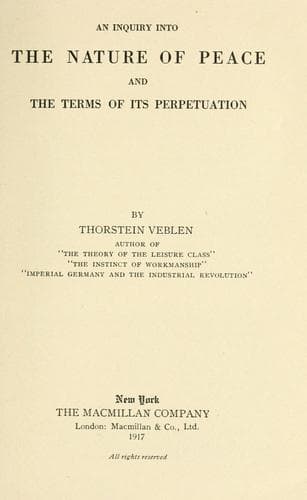
An Inquiry into the Nature of Peace and the Terms of Its PerpetuationVeblen, Thorstein
Philosophy
An Inquiry into the Nature of Peace and the Terms of Its Perpetuation
Veblen, Thorstein
Peace; World War, 1914-1918 -- Peace
Both of these elements of incipient disturbance in the dynastic economy,
the modern commercial and working classes, are creatures of the new era;
and they are systematically out of line with the received dynastic
tradition of fealty, both in respect of their pecuniary interests and in
respect of that discipline of experience to which their workday
employment subjects them. They are substantially the same two classes or
groupings that came forward in the modernisation of the British
community, with a gradual segregation of interest and a consequent
induced solidarity of class sentiment and class animosities. But with
the difference that in the British case the movement of changing
circumstances was slow enough to allow a fair degree of habituation to
the altered economic conditions; whereas in the German case the move
into modern economic conditions has been made so precipitately as to
have carried the mediaeval frame of mind over virtually intact into this
era of large business and machine industry. In the Fatherland the
commercial and industrial classes have been called on to play their part
without time to learn their lines.
The case of the English-speaking peoples, who have gone over this course
of experience in more consecutive fashion than any others, teaches that
in the long run, if these modern economic conditions persist, one or the
other or both of these creatures of the modern era must prevail, and
must put the dynastic establishment out of commission; although the
sequel has not yet been seen in this British case, and there is no
ground afforded for inference as to which of the two will have the
fortune to survive and be invested with the hegemony. Meantime the
opportunity of the Imperial establishment to push its enterprise in
dominion lies in the interval of time so required for the discipline of
experience under modern conditions to work out through the growth of
modern habits of thought into such modern (i.e. civilised) institutional
forms and such settled principles of personal insubordination as will
put any effectual dynastic establishment out of commission. The same
interval of time, that must so be allowed for the decay of the dynastic
spirit among the German people under the discipline of life by the
methods of modern trade and industry, marks the period during which no
peace compact will be practicable, except with the elimination of the
Imperial establishment as a possible warlike power. All this, of
course, applies to the case of Japan as well, with the difference that
while the Japanese people are farther in arrears, they are also a
smaller, less formidable body, more exposed to outside forces, and their
mediaevalism is of a more archaic and therefore more precarious type.
Public-domain text, read in full here on John Shaqi.
Reviews
Reviews
No reviews yet
Be the first to share your thoughts on this work.
Elsewhere in the archive
Join the Discussion
Join the discussion
Sign in to leave a comment or review.
Sign InorCreate an account