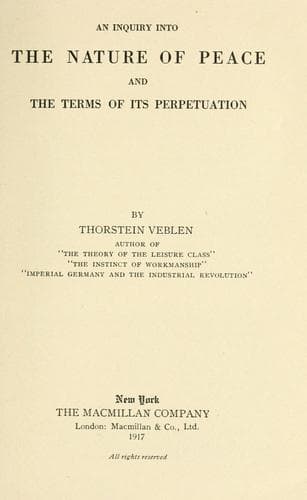
An Inquiry into the Nature of Peace and the Terms of Its PerpetuationVeblen, Thorstein
Philosophy
An Inquiry into the Nature of Peace and the Terms of Its Perpetuation
Veblen, Thorstein
Peace; World War, 1914-1918 -- Peace
What makes this German Imperial establishment redoubtable, beyond
comparison, is the very simple but also very grave combination of
circumstances whereby the German people have acquired the use of the
modern industrial arts in the highest state of efficiency, at the same
time that they have retained unabated the fanatical loyalty of feudal
barbarism.[9] So long, and in so far, as this conjunction of forces
holds there is no outlook for peace except on the elimination of
Germany as a power capable of disturbing the peace.
[Footnote 9: For an extended discussion of this point, see _Imperial
Germany and the Industrial Revolution_, especially ch. v. and vi.]
It may seem invidious to speak so recurrently of the German Imperial
establishment as the sole potential disturber of the peace in Europe.
The reason for so singling out the Empire for this invidious
distinction--of merit or demerit, as one may incline to take it--is that
the facts run that way. There is, of course, other human material, and
no small volume of it in the aggregate, that is of much the same
character, and serviceable for the same purposes as the resources and
man-power of the Empire. But this other material can come effectually
into bearing as a means of disturbance only in so far as it clusters
about the Imperial dynasty and marches under his banners. In so speaking
of the Imperial establishment as the sole enemy of a European peace,
therefore, these outlying others are taken for granted, very much as one
takes the nimbus for granted in speaking of one of the greater saints of
God.
* * * * *
So the argument returns to the alternative: Peace by unconditional
surrender and submission, or peace by elimination of Imperial Germany
(and Japan). There is no middle course apparent. The old-fashioned--that
is to say nineteenth-century--plan of competitive defensive armament and
a balance of powers has been tried, and it has not proved to be a
success, even so early in the twentieth century. This plan offers a
substitute (_Ersatz_) for peace; but even as such it has become
impracticable. The modern, or rather the current late-modern, state of
the industrial arts does not tolerate it. Technological knowledge has
thrown the advantage in military affairs definitively to the offensive,
particularly to the offensive that is prepared beforehand with the
suitable appliances and with men ready matured in that rigorous and
protracted training by which alone they can become competent to make
warlike use of these suitable appliances provided by the modern
technology. At the same time, and by grace of the same advance in
technology, any well-designed offensive can effectually reach any given
community, in spite of distance or of other natural obstacles. The era
of defensive armaments and diplomatic equilibration, as a substitute for
peace, has been definitively closed by the modern state of the
industrial arts.
Public-domain text, read in full here on John Shaqi.
Reviews
Reviews
No reviews yet
Be the first to share your thoughts on this work.
Elsewhere in the archive
Join the Discussion
Join the discussion
Sign in to leave a comment or review.
Sign InorCreate an account