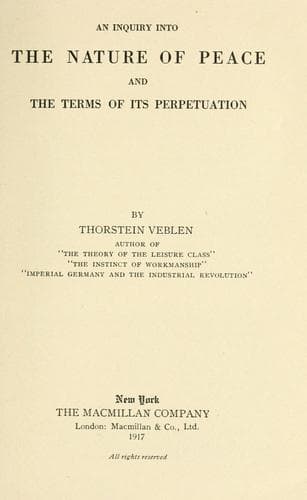
An Inquiry into the Nature of Peace and the Terms of Its PerpetuationVeblen, Thorstein
Philosophy
An Inquiry into the Nature of Peace and the Terms of Its Perpetuation
Veblen, Thorstein
Peace; World War, 1914-1918 -- Peace
State now seems to the subjects of the Fatherland. There is, in effect,
no disputing about tastes.
There is little that is novel, and nothing that is to be rated as
constructive innovation, in this sketch of what might not inaptly be
called peace by neglect. The legal mind, which commonly takes the
initiative in counsels on what to do, should scarcely be expected to
look in that direction for a way out, or to see its way out in that
direction in any case; so that it need occasion no surprise if the many
current projects of pacification turn on ingenious and elaborate
provisions of apparatus and procedure, rather than on that simpler line
of expedients which the drift of circumstance, being not possessed of a
legal mind, has employed in the sequence of institutional change
hitherto. The legal mind that dominates in the current deliberations on
peace is at home in exhaustive specifications and meticulous
demarkations, and it is therefore prone to seek a remedy for the burden
of supernumerary devices by recourse to further excesses of regulation.
This trait of the legal mind is not a bad fault at the worst, and the
quality in which this defect inheres is of the greatest moment in any
project of constructive engineering on the legal and political plane.
But it is less to the purpose, indeed it is at cross purposes, in such a
conjuncture as the present; when the nations are held up in their quest
of peace chiefly by an accumulation of institutional apparatus that has
out-stayed its usefulness. It is the fortune even of good institutions
to become imbecile with the change of conditioning circumstances, and it
then becomes a question of their disestablishment, not of their
rehabilitation. If there is anywhere a safe negative conclusion, it is
that an institution grown mischievous by obsolescence need not be
replaced by a substitute.
Instances of such mischievous institutional arrangements, obsolete or in
process of obsolescence, would be, e.g., the French monarchy of the
ancient regime, the Spanish Inquisition, the British corn laws and the
"rotten boroughs," the Barbary pirates, the Turkish rule in Armenia, the
British crown, the German Imperial Dynasty, the European balance of
powers, the Monroe Doctrine. In some sense, at least in the sense and
degree implied in their selective survival, these various articles of
institutional furniture, and many like them, have once presumably been
suitable to some end, in the days of their origin and vigorous growth;
and they have at least in some passable fashion met some felt want; but
if they ever had a place and use in the human economy they have in time
grown imbecile and mischievous by force of changing circumstances, and
the question is not how to replace them with something else to the same
purpose after their purpose is outworn. A man who loses a wart off the
end of his nose does not apply to the _Ersatz_ bureau for a convenient
substitute.
Public-domain text, read in full here on John Shaqi.
Reviews
Reviews
No reviews yet
Be the first to share your thoughts on this work.
Elsewhere in the archive
Join the Discussion
Join the discussion
Sign in to leave a comment or review.
Sign InorCreate an account