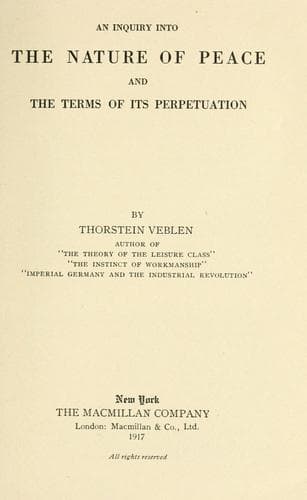
An Inquiry into the Nature of Peace and the Terms of Its PerpetuationVeblen, Thorstein
Philosophy
An Inquiry into the Nature of Peace and the Terms of Its Perpetuation
Veblen, Thorstein
Peace; World War, 1914-1918 -- Peace
On the establishment of such a neutral league, with such neutralisation
of national interests as would assure concerted action in time of
stress, the need of armament on the part of the American republic would
disappear, at least to the extent that no increase of armed force would
be advisable. The strength of the Republic lies in its large and varied
resources and the unequalled industrial capacity of its population,--a
capacity which is today seriously hampered by untoward business
interests and business methods sheltered under national discrimination,
but which would come more nearly to its own so soon as these national
discriminations were corrected or abrogated in the neutralisation of
national pretensions. The neutrally-minded countries of Europe have been
constrained to learn the art of modern war, as also to equip themselves
with the necessary appliances, sufficient to meet all requirements for
keeping the peace through such a period as can or need be taken into
account,--provided the peace that is to come on the conclusion of the
present war shall be placed on so "conclusive" a footing as will make it
anything substantially more than a season of recuperation for that
warlike Power about whose enterprise in dominion the whole question
turns. Provided that suitably "substantial guarantees" of a reasonable
quiescence on the part of this Imperial Power are had, there need be no
increase of the American armament. Any increased armament would in that
case amount to nothing better than an idle duplication of plant and
personnel already on hand and sufficient to meet the requirements.
To meet the contingencies had in view in its formation, such a league
would have to be neutralised to the point that all pertinent national
pretensions would fall into virtual abeyance, so that all the necessary
resources at the disposal of the federated nations would automatically
come under the control of the league's appointed authorities without
loss of time, whenever the need might arise. That is to say, national
interests and pretensions would have to give way to a collective control
sufficient to insure prompt and concerted action. In the face of such a
neutral league Imperial Japan alone would be unable to make a really
serious diversion or to entertain much hope of following up its quest of
dominion. The Japanese Imperial establishment might even be persuaded
peaceably to let its unoffending neighbours live their own life
according to their own light. It is, indeed, possibly the apprehension
of some such contingency that has hurried the rapacity of the Island
Empire into the headlong indecencies of the past year or two.
CHAPTER VI
ELIMINATION OF THE UNFIT
Public-domain text, read in full here on John Shaqi.
Reviews
Reviews
No reviews yet
Be the first to share your thoughts on this work.
Elsewhere in the archive
Join the Discussion
Join the discussion
Sign in to leave a comment or review.
Sign InorCreate an account