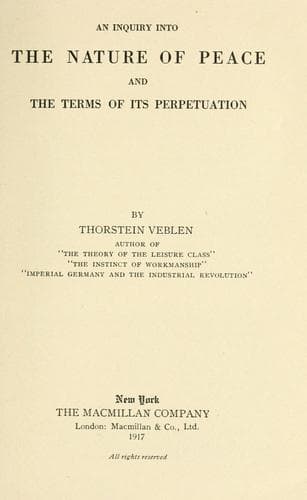
An Inquiry into the Nature of Peace and the Terms of Its PerpetuationVeblen, Thorstein
Philosophy
An Inquiry into the Nature of Peace and the Terms of Its Perpetuation
Veblen, Thorstein
Peace; World War, 1914-1918 -- Peace
This is coming to be informally and loosely, but none the less
definitively, realised by the pacific nations; and the realisation of it
is gaining in clearness and assurance as time passes. And it is backed
by the conviction that, in the nature of things, no engagement on the
part of such a dynastic State has any slightest binding force, beyond
the material constraint that would enforce it from the outside. So the
demand has been diplomatically phrased as a demand for "substantial
guarantees." Any gain in resources on the part of these Powers is to be
counted as a gain in the ways and means of disturbing the peace, without
reservation.
The pacific nations include among them two large items, both of which
are indispensable to the success of the project, the United States and
the United Kingdom. The former brings in its train, virtually without
exception or question, the other American republics, none of which can
practicably go in or stay out except in company and collusion with the
United States. The United Kingdom after the same fashion, and with
scarcely less assurance, may be counted on to carry the British
colonies. Evidently, without both of these groups the project would not
even make a beginning. Beyond this is to be counted in as elements of
strength, though scarcely indispensable, France, Belgium, the
Netherlands and the Scandinavian countries. The other west-European
nations would in all probability be found in the league, although so far
as regards its work and its fortunes their adhesion would scarcely be a
matter of decisive consequence; they may therefore be left somewhat on
one side in any consideration of the circumstances that would shape the
league, its aims and its limitations. The Balkan states, in the wider
acceptance, they that frequent the Sign of the Double Cross, are
similarly negligible in respect of the organisation of such a league or
its resources and the mutual concessions necessary to be made between
its chief members. Russia is so doubtful a factor, particularly as
regards its place and value in industry, culture and politics, in the
near future, as to admit nothing much more than a doubt on what its
relation to the situation will be. The evil intentions of the
Imperial-bureaucratic establishment are probably no more to be
questioned than the good intentions of the underlying peoples of Russia.
China will have to be taken in, if for no other reason than the use to
which the magnificent resources of that country would be turned by its
Imperial neighbour in the absence of insurmountable interference from
outside. But China will come in on any terms that include neutrality and
security.
Public-domain text, read in full here on John Shaqi.
Reviews
Reviews
No reviews yet
Be the first to share your thoughts on this work.
Elsewhere in the archive
Join the Discussion
Join the discussion
Sign in to leave a comment or review.
Sign InorCreate an account