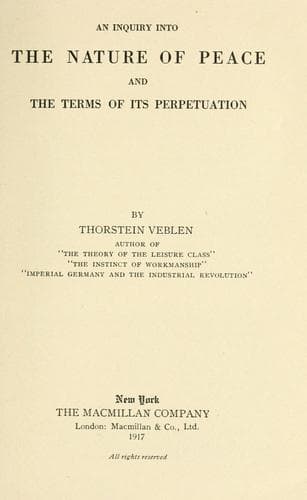
An Inquiry into the Nature of Peace and the Terms of Its PerpetuationVeblen, Thorstein
Philosophy
An Inquiry into the Nature of Peace and the Terms of Its Perpetuation
Veblen, Thorstein
Peace; World War, 1914-1918 -- Peace
The end in this case is peace and security; which means, for practical
purposes, peace and good-will. Ill-will is not a secure foundation of
peace. Even the military strategists of the Imperial establishment
recommend a programme of "frightfulness" only as a convenient military
expedient, essentially a provisional basis of tranquility. In the long
run and as a permanent peace measure it is doubtless not to the point.
Security is finally to be had among or between modern peoples only on
the ground of a common understanding and an impartially common basis of
equity, or something approaching that basis as nearly as circumstances
will permit. Which means that in so far as the projected peace-compact
is to take effect in any enduring way, and leave the federated nations
some degree of freedom from persistent apprehension and animosity, as
well as from habitual insecurity of life and limb, the league must not
only be all-inclusive, but it must be inclusively uniform in all its
requirements and regulations.
The peoples of the quondam Imperial nations must come into the league on
a footing of formal equality with the rest. This they can not do without
the virtual abdication of their dynastic governmental establishments and
a consequent shift to a democratic form of organisation, and a formal
abrogation of class privileges and prerogatives.
However, a virtual abdication or cancelment of the dynastic rule, such
as to bring it formally into the same class with the British crown,
would scarcely meet the requirements in the case of the German Imperial
establishment; still more patently not in the case of Imperial Japan.
If, following the outlines of the decayed British crown, one or the
other of these Imperial establishments were by formal enactment reduced
to a state of nominal desuetude, the effect would be very appreciably
different from what happens in the British community, where the crown
has lost its powers by failure of the requisite subordination on the
part of the people, and not by a formal abdication of rights. In the
German case, and even more in the Japanese case, the strength of the
Imperial establishment lies in the unimpaired loyalty of the populace;
which would remain nearly intact at the outset, and would thin out only
by insensible degrees in the sequel; so that if only the Imperial
establishment were left formally standing it would command the fealty of
the common run in spite of any formal abrogation of its powers, and the
course of things would, in effect, run as before the break. In effect,
to bring about a shift to a democratic basis the dynastic slate would
have to be wiped very clean indeed. And this shift would be
indispensable to the successful conduct of such a pacific league of
nations, since any other than an effectually democratic national
establishment is to be counted on unfailingly to intrigue for dynastic
aggrandizement, through good report and evil.
Public-domain text, read in full here on John Shaqi.
Reviews
Reviews
No reviews yet
Be the first to share your thoughts on this work.
Elsewhere in the archive
Join the Discussion
Join the discussion
Sign in to leave a comment or review.
Sign InorCreate an account