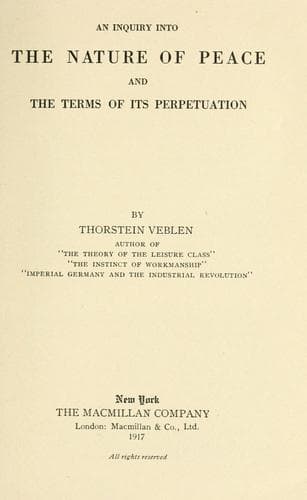
An Inquiry into the Nature of Peace and the Terms of Its PerpetuationVeblen, Thorstein
Philosophy
An Inquiry into the Nature of Peace and the Terms of Its Perpetuation
Veblen, Thorstein
Peace; World War, 1914-1918 -- Peace
Through the course of the nineteenth century the British government had
progressively been taking on the complexion of a "gentlemen's
agreement;" a government by gentlemen, for gentlemen, and of gentlemen,
too, beyond what could well be alleged in any other known instance,
though never wholly so. No government could be a government of gentlemen
exclusively, since there is no pecuniary profit in gentlemen as such,
and therefore no object in governing them; more particularly could there
never be any incentive in it for gentlemen, whose livelihood is, in the
nature of the case, drawn from some one else. A gentlemen's government
can escape death by inanition only in so far as it serves the material
interest of its class, as contrasted with the underlying population from
which the class draws its livelihood. This British arrangement of a
government by prudent and humane gentlemen with a view to the
conservation of that state of things that best conduced to the material
well-being of their own class, has on the whole had the loyal support of
the underlying populace, with an occasional floundering protest. But
the protest has never taken the shape of an expressed distrust of
gentlemen, considered as the staple ways and means of government; nor
has the direction of affairs ever descended into the hands of any other
or lower class or condition of men.
On the whole, this British arrangement for the control of national
affairs by a body of interested gentlemen-investors has been, and
perhaps still is, just as well at home in the affectionate
preconceptions of the nineteenth-century British as the corresponding
German usufruct by self-appointed swaggering aristocrats has been among
the underlying German population, or as the American arrangement of
national control by business men for business ends. The British and the
American arrangements run very much to the same substantial effect, of
course, inasmuch as the British gentlemen represent, as a class, the
filial generations of a business community, and their aims and standards
of conduct continue to be such as are enforced by the pecuniary
interests on which their gentility is conditioned. They continue to draw
the ways and means of a worthy life from businesslike arrangements of a
"vested" character, made and provided with a view to their nourishment
and repose. Their resulting usufruct of the community's productive
efforts rests on a vested interest of a pecuniary sort, sanctioned by
the sacred rights of property; very much as the analogous German
dynastic and aristocratic usufruct rests on personal prerogative,
sanctioned by the sacred rights of authentic prescription, without
afterthought. The two, it will be noted are very much alike, in effect,
"under the skin." The great distinguishing mark being that the German
usufructuary gentlemen are, in theory at least, gentlemen-adventurers of
prowess and proud words, whose place in the world's economy it is to
Public-domain text, read in full here on John Shaqi.
Reviews
Reviews
No reviews yet
Be the first to share your thoughts on this work.
Elsewhere in the archive
Join the Discussion
Join the discussion
Sign in to leave a comment or review.
Sign InorCreate an account