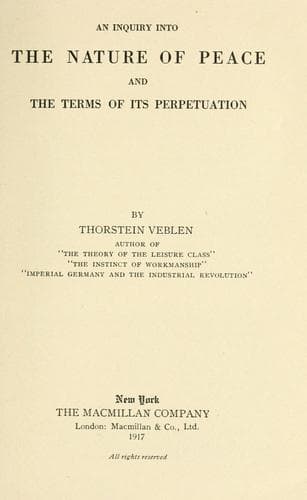
An Inquiry into the Nature of Peace and the Terms of Its PerpetuationVeblen, Thorstein
Philosophy
An Inquiry into the Nature of Peace and the Terms of Its Perpetuation
Veblen, Thorstein
Peace; World War, 1914-1918 -- Peace
such financial transactions as are incident to the accomplishment of
anything whatever in a commercial nation. And then, too, there is a
pecuniary interest in being interested in financial transactions.
This shifting of discretionary control out of the hands of the gentlemen
into those of the underbred common run, who know how to do what is
necessary to be done in the face of underbred exigencies, may
conceivably go far when it has once been started, and it may go forward
at an accelerated rate if the pressure of necessity lasts long enough.
If time be given for habituation to this manner of directorate in
national affairs, so that the common man comes to realise how it is
feasible to get along without gentlemen-investors holding the
discretion, the outcome may conceivably be very grave. It is a point in
doubt, but it is conceivable that in such a case the gentlemanly
executive committee administering affairs in the light of the
gentlemanly pecuniary interest, will not be fully reinstated in the
discretionary control of the United Kingdom for an appreciable number of
years after the return of peace. Possibly, even, the regime may be
permanently deranged, and there is even a shadowy doubt possible to be
entertained as to whether the vested pecuniary rights, on which the
class of gentlemen rests, may not suffer some derangement, in case the
control should pass into the hands of the underbred and unpropertied for
so long a season as to let the common man get used to thinking that the
vested interests and the sacred rights of gentility are so much ado
about nothing.
Such an outcome would be extreme, but as a remote contingency it is to
be taken into account. The privileged classes of the United Kingdom
should by this time be able to see the danger there may be for them and
their vested interests, pecuniary and moral, in an excessive
prolongation of the war; in such postponement of peace as would afford
time for a popular realisation of their incompetence and
disserviceability as touches the nation's material well-being under
modern conditions. To let the nation's war experience work to such an
outcome, the season of war would have to be prolonged beyond what either
the hopes or the fears of the community have yet contemplated; but the
point is after all worth noting, as being within the premises of the
case, that there is herein a remote contingency of losing, at least for
a time, that unformulated clause in the British constitution which has
hitherto restricted the holding of responsible office to men of pedigree
and of gentle breeding, or at least of very grave pecuniary weight; so
grave as to make the incumbents virtual gentlemen, with a virtual
pedigree, and with a virtual gentleman's accentuated sense of class
interest. Should such an eventuality overtake British popular sentiment
and belief there is also the remote contingency that the rights of
ownership and investment would lose a degree of sanctity.
Public-domain text, read in full here on John Shaqi.
Reviews
Reviews
No reviews yet
Be the first to share your thoughts on this work.
Elsewhere in the archive
Join the Discussion
Join the discussion
Sign in to leave a comment or review.
Sign InorCreate an account