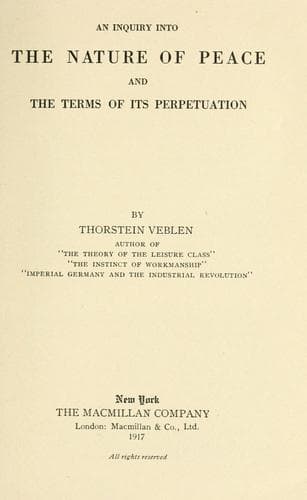
An Inquiry into the Nature of Peace and the Terms of Its PerpetuationVeblen, Thorstein
Philosophy
An Inquiry into the Nature of Peace and the Terms of Its Perpetuation
Veblen, Thorstein
Peace; World War, 1914-1918 -- Peace
In a large country, such as America or Russia, which comprises within
its national boundaries very extensive and very varied resources and a
widely distributed and diversified population, the mischief suffered
from restraints of trade that hinder industrial relations with the world
at large will of course be proportionately lessened. Such a country
comes nearer being a miniature industrial world; although none of the
civilised nations, large or small, can carry on its ordinary industrial
activities and its ordinary manner of life without drawing on foreign
parts to some appreciable extent. But a country of small territorial
extent and of somewhat narrowly restricted natural resources, as, e.g.,
Germany or France, can even by the most drastic measures of restraint
and mutilation achieve only a very mediocre degree of industrial
isolation and "self-sufficiency,"--as has, e.g., appeared in the present
war. But in all cases, though in varying measure, the mitigated
isolation so enforced by these restraints on trade will in their degree
impair the country's industrial efficiency and lower the people's
material well-being; yet, if the restrictions are shrewdly applied this
partial isolation and partial "self-sufficiency" will go some way toward
preparing the nation for the more thorough isolation that follows on the
outbreak of hostilities.
The present plight of the German people under war conditions may serve
to show how nearly that end may be attained, and yet how inadequate even
the most unreserved measures of industrial isolation must be in face of
the fact that the modern state of the industrial arts necessarily draws
on the collective resources of the world at large. It may well be
doubted, on an impartial view, if the mutilation of the country's
industrial system by such measures of isolation does not after all
rather weaken the nation even for warlike ends; but then, the
discretionary authorities in the dynastic States are always, and it may
be presumed necessarily, hampered with obsolete theories handed down
from that cameralistic age, when the little princes of the Fatherland
were making dynastic history. So, e.g., the current, nineteenth and
twentieth century, economic policy of the Prussian-Imperial statesmen is
still drawn on lines within which Frederick II, called the Great, would
have felt well at home.
Public-domain text, read in full here on John Shaqi.
Reviews
Reviews
No reviews yet
Be the first to share your thoughts on this work.
Elsewhere in the archive
Join the Discussion
Join the discussion
Sign in to leave a comment or review.
Sign InorCreate an account