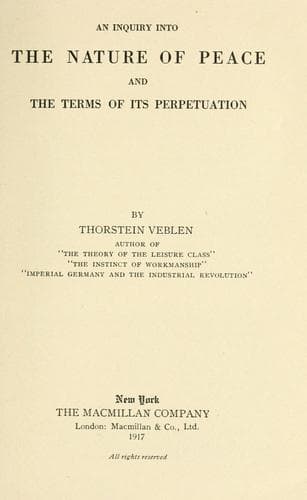
An Inquiry into the Nature of Peace and the Terms of Its PerpetuationVeblen, Thorstein
Philosophy
An Inquiry into the Nature of Peace and the Terms of Its Perpetuation
Veblen, Thorstein
Peace; World War, 1914-1918 -- Peace
The theory, i.e. the logical necessities, of such a pacific league of
neutral nations is simple enough, in its elements. War is to be avoided
by a policy of avoidance. Which signifies that the means and the motives
to warlike enterprise and warlike provocation are to be put away, so far
as may be. If what may be, in this respect, does not come up to the
requirements of the case, the experiment, of course, will fail. The
preliminary requirement,--elimination of the one formidable dynastic
State in Europe,--has been spoken of. Its counterpart in the Far East
will cease to be formidable on the decease of its natural ally in
Central Europe, in so far as touches the case of such a projected
league. The ever increasingly dubious empire of the Czar would appear to
fall in the same category. So that the pacific league's fortunes would
seem to turn on what may be called its domestic or internal
arrangements.
Now, the means of warlike enterprise, as well as of unadvised
embroilment, is always in the last analysis the patriotic spirit of the
nation. Given this patriotic spirit in sufficient measure, both the
material equipment and the provocation to hostilities will easily be
found. It should accordingly appear to be the first care of such a
pacific league to reduce the sources of patriotic incitement to the
practicable minimum. This can be done, in such measure as it can be done
at all, by neutralisation of national pretensions. The finished outcome
in this respect, such as would assure perpetual peace among the peoples
concerned, would of course be an unconditional neutralisation of
citizenship, as has already been indicated before. The question which,
in effect, the spokesmen for a pacific league have to face is as to how
nearly that outcome can be brought to pass. The rest of what they may
undertake, or may come to by way of compromise and stipulation, is
relatively immaterial and of relatively transient consequence.
A neutralisation of citizenship has of course been afloat in a somewhat
loose way in the projects of socialistic and other "undesirable"
agitators, but nothing much has come of it. Nor have specific projects
for its realisation been set afoot. That anything conclusive along that
line could now be reached would seem extremely doubtful, in view of the
ardent patriotic temper of all these peoples, heightened just now by the
experience of war. Still, an undesigned and unguided drift in that
direction has been visible in all those nations that are accounted the
vanguard among modern civilised peoples, ever since the dynastic rule
among them began to be displaced by a growth of "free" institutions,
that is to say institutions resting on an accepted ground of
insubordination and free initiative.
Public-domain text, read in full here on John Shaqi.
Reviews
Reviews
No reviews yet
Be the first to share your thoughts on this work.
Elsewhere in the archive
Join the Discussion
Join the discussion
Sign in to leave a comment or review.
Sign InorCreate an account