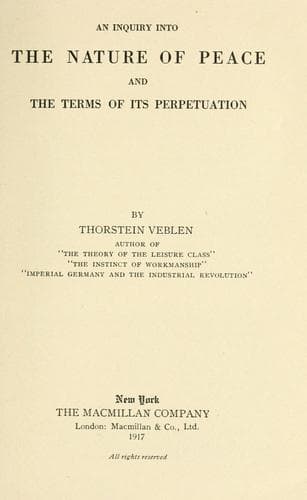
An Inquiry into the Nature of Peace and the Terms of Its PerpetuationVeblen, Thorstein
Philosophy
An Inquiry into the Nature of Peace and the Terms of Its Perpetuation
Veblen, Thorstein
Peace; World War, 1914-1918 -- Peace
In those nations that have made up the advance guard of Western
civilisation in its movement out of feudalism, the disintegrating effect
of this matter-of-fact animus inculcated by the later state of the
industrial arts has apparently acted effectively, in some degree, to
discredit those preconceptions of personal discrimination on which
dynastic rule is founded. But in no case has the discipline of this
mechanistic technology yet wrought its perfect work or come to a
definitive conclusion. Meantime war and politics have on the whole
continued on the ancient plane; it may perhaps be fair to say that
politics has so continued because warlike enterprise has continued still
to be a matter of such personal forces as skill, dexterity and judgment,
valor and cunning, personal force and fraud. Latterly, gradually, but
increasingly, the technology of war, too, has been shifting to the
mechanistic plane; until in the latest phases of it, somewhere about the
turn of the century, it is evident that the logic of warfare too has
come to be the same mechanistic logic that makes the modern state of the
industrial arts.
What, if anything, is due by consequence to overtake the political
strategy and the political preconceptions of the new century, is a
question that will obtrude itself, though with scant hope of finding a
ready answer. It may even seem a rash, as well as an ungraceful,
undertaking to inquire into the possible manner and degree of
prospective decay to which the received political ideals and virtues
would appear to be exposed by consequence of this derangement of the
ancient discipline to which men have been subjected. So much, however,
would seem evident, that the received virtues and ideals of patriotic
animosity and national jealousy can best be guarded against untimely
decay by resolutely holding to the formal observance of all outworn
punctilios of national integrity and discrimination, in spite of their
increasing disserviceability,--as would be done, e.g., or at least
sought to be done, in the installation of a league of neutral nations to
keep the peace and at the same time to safeguard those "national
interests" whose only use is to divide these nations and keep them in a
state of mutual envy and distrust.
* * * * *
Those peoples who are subject to the constraining governance of this
modern state of the industrial arts, as all modern peoples are in much
the same measure in which they are "modern," are, therefore, exposed to
a workday discipline running at cross purposes with the received law and
order as it takes effect in national affairs; and to this is to be added
that, with warlike enterprise also shifted to this same
mechanistic-technological ground, war can no longer be counted on so
confidently as before to correct all the consequent drift away from the
ancient landmarks of dynastic, pseudo-dynastic, and national enterprise
in dominion.
Public-domain text, read in full here on John Shaqi.
Reviews
Reviews
No reviews yet
Be the first to share your thoughts on this work.
Elsewhere in the archive
Join the Discussion
Join the discussion
Sign in to leave a comment or review.
Sign InorCreate an account