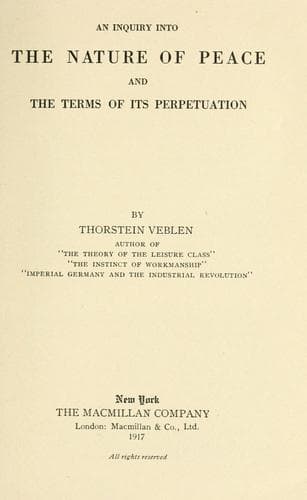
An Inquiry into the Nature of Peace and the Terms of Its PerpetuationVeblen, Thorstein
Philosophy
An Inquiry into the Nature of Peace and the Terms of Its Perpetuation
Veblen, Thorstein
Peace; World War, 1914-1918 -- Peace
Still, when all is told, it will probably have to be conceded that,
e.g., such a nation as Russia will fall under this rule of inherent
disability imposed by the necessary use of the modern industrial arts.
Without a fairly full and free command of these modern industrial
methods on the part of the Russian people, together with the virtual
disappearance of illiteracy, and with the facile and far-reaching system
of communication which it all involves, the Russian Imperial
establishment would not be a formidable power or a serious menace to the
pacific nations; and it is not easy to imagine how the Imperial
establishment could retain its hold and its character under the
conditions indicated.
The case of Japan, taken by itself, rests on somewhat similar lines as
these others. In time, and in this case the time-allowance should
presumably not be anything very large, the Japanese people are likely to
get an adequate command of the modern technology; which would, here as
elsewhere, involve the virtual disappearance of the present high
illiteracy, and the loss, in some passable measure, of the current
superstitiously crass nationalism of that people. There are indications
that something of that kind, and of quite disquieting dimensions, is
already under way; though with no indication that any consequent
disintegrating habits of thought have yet invaded the sacred close of
Japanese patriotic devotion.
Again, it is a question of time and habituation. With time and
habituation the emperor may insensibly cease to be of divine pedigree,
and the syndicate of statesmen who are doing business under his
signature may consequently find their measures of Imperial expansion
questioned by the people who pay the bills. But so long as the Imperial
syndicate enjoy their present immunity from outside obstruction, and can
accordingly carry on an uninterrupted campaign of cumulative predation
in Korea, China and Manchuria, the patriotic infatuation is less likely
to fall off, and by so much the decay of Japanese loyalty will be
retarded. Yet, even if allowed anything that may seem at all probable in
the way of a free hand for aggression against their hapless neighbours,
the skepticism and insubordination to personal rule that seems
inseparable in the long run from addiction to the modern industrial arts
should be expected presently to overtake the Japanese spirit of loyal
servitude. And the opportunity of Imperial Japan lies in the interval.
So also does the menace of Imperial Japan as a presumptive disturber of
the peace at large.
* * * * *
Public-domain text, read in full here on John Shaqi.
Reviews
Reviews
No reviews yet
Be the first to share your thoughts on this work.
Elsewhere in the archive
Join the Discussion
Join the discussion
Sign in to leave a comment or review.
Sign InorCreate an account