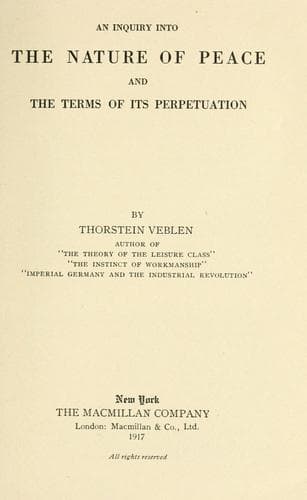
An Inquiry into the Nature of Peace and the Terms of Its PerpetuationVeblen, Thorstein
Philosophy
An Inquiry into the Nature of Peace and the Terms of Its Perpetuation
Veblen, Thorstein
Peace; World War, 1914-1918 -- Peace
There is also an insidious suggestion, carrying a sinister note of
discredit, that comes in from ethnological science at this point; which
is adapted still further to derange the common man's faith in this
received institution of ownership and its control of the material
equipment of industry. To students interested in human culture it is a
matter of course that this material equipment is a means of utilising
the state of the industrial arts; that it is useful in industry and
profitable to its owners only because and in so far as it is a creation
of the current technological knowledge and enables its owner to
appropriate the usufruct of the current industrial arts. It is likewise
a matter of course that this technological knowledge, that so enables
the material equipment to serve the purposes of production and of
private gain, is a free gift of the community at large to the owners of
industrial plant; and, under latterday conditions, to them exclusively.
The state of the industrial arts is a joint heritage of the community at
large, but where, as in the modern countries, the work to be done by
this technology requires a large material equipment, the usufruct of
this joint heritage passes, in effect, into the hands of the owners of
this large material equipment.
These owners have, ordinarily, contributed nothing to the technology,
the state of the industrial arts, from which their control of the
material equipment of industry enables them to derive a gain. Indeed, no
class or condition of men in the modern community--with the possible
exception of politicians and the clergy--can conceivably contribute less
to the community's store of technological knowledge than the large
owners of invested wealth. By one of those singular inversions due to
production being managed for private gain, it happens that these
investors are not only not given to the increase and diffusion of
technological knowledge, but they have a well-advised interest in
retarding or defeating improvements in the industrial arts in detail.
Improvements, innovations that heighten productive efficiency in the
general line of production in which a given investment is placed, are
commonly to be counted on to bring "obsolescence by supersession" to the
plant already engaged in that line; and therefore to bring a decline in
its income-yielding capacity, and so in its capital or investment value.
Public-domain text, read in full here on John Shaqi.
Reviews
Reviews
No reviews yet
Be the first to share your thoughts on this work.
Elsewhere in the archive
Join the Discussion
Join the discussion
Sign in to leave a comment or review.
Sign InorCreate an account