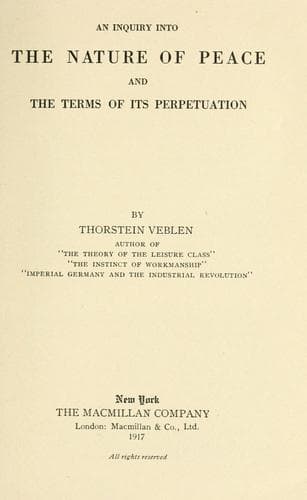
An Inquiry into the Nature of Peace and the Terms of Its PerpetuationVeblen, Thorstein
Philosophy
An Inquiry into the Nature of Peace and the Terms of Its Perpetuation
Veblen, Thorstein
Peace; World War, 1914-1918 -- Peace
To anyone who is inclined to see these matters of usage in the light of
their history and to appraise them as phenomena of habituation,
adaptation and supersession in the sequence of cultural proliferation,
there should be no difficulty in appreciating that this institution of
ownership that makes the core of the modern institutional structure is
a precipitate of custom, like any other item of use and wont; and that,
like any other article of institutional furniture, it is subject to the
contingencies of supersession and obsolescence. If prevalent habits of
thought, enforced by the prevalent exigencies of life and livelihood,
come to change in such a way as to make life under the rule imposed by
this institution seem irksome, or intolerable, to the mass of the
population; and if at the same time things turn in such a way as to
leave no other and more urgent interest or exigency to take precedence
of this one and hinder its being pushed to an issue; then it should
reasonably follow that contention is due to arise between the unblest
mass on whose life it is a burden and the classes who live by it. But it
is, of course, impossible to state beforehand what will be the precise
line of cleavage or what form the division between the two parties in
interest will take. Yet it is contained in the premises that, barring
unforeseen contingencies of a formidable magnitude, such a cleavage is
due to follow as a logical sequel of an enduring peace at large. And it
is also well within the possibilities of the case that this issue may
work into an interruption or disruption of the peace between the
nations.
In this connection it may be called to mind that the existing
governmental establishments in these pacific nations are, in all cases,
in the hands of the beneficiary, or kept classes,--beneficiaries in the
sense in which a distinction to that effect comes into the premises of
the case at this point. The responsible officials and their chief
administrative officers,--so much as may at all reasonably be called the
"Government" or the "Administration,"--are quite invariably and
characteristically drawn from these beneficiary classes; nobles,
gentlemen, or business men, which all comes to the same thing for the
purpose in hand; the point of it all being that the common man does not
come within these precincts and does not share in these counsels that
assume to guide the destiny of the nations.
Public-domain text, read in full here on John Shaqi.
Reviews
Reviews
No reviews yet
Be the first to share your thoughts on this work.
Elsewhere in the archive
Join the Discussion
Join the discussion
Sign in to leave a comment or review.
Sign InorCreate an account