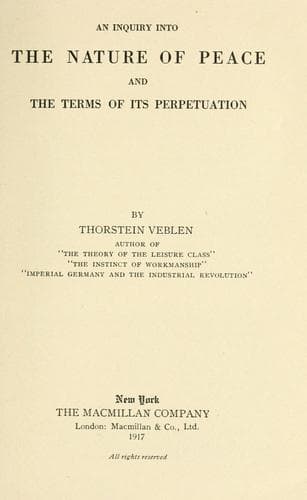
An Inquiry into the Nature of Peace and the Terms of Its PerpetuationVeblen, Thorstein
Philosophy
An Inquiry into the Nature of Peace and the Terms of Its Perpetuation
Veblen, Thorstein
Peace; World War, 1914-1918 -- Peace
In cases where no recapitalisation has been effected for a considerable
series of years the yearly earnings of such businesslike coalitions have
been known to approach fifty percent on the capitalised value. Commonly,
however, when earnings rise to a striking figure, the business will be
recapitalised on the basis of its earning-capacity, by issue of a stock
dividend, by reincorporation in a new combination with an increased
capitalisation, and the like. Such augmentation of capital not unusually
has been spoken of by theoretical writers and publicists as an increase
of the community's wealth, due to savings; an analysis of any given case
is likely to show that its increased capital value represents an
increasingly profitable procedure for securing a high price above cost,
by stopping the available output short of the productive capacity of the
industries involved. Loosely speaking, and within the limits of what the
traffic will bear, the gains in such a case are proportioned to the
deficiency by which the production or supply under control falls short
of productive capacity. So that the capitalisation in the case comes to
bear a rough proportion to the material loss which this organisation of
sabotage is enabled to inflict on the community at large; and instead of
its being a capitalisation of serviceable means of production it may,
now and again, come to little else than a capitalisation of chartered
sabotage.
Under the new dispensation of peace and security at large this manner of
capitalisation and business enterprise might reasonably be expected to
gain something in scope and security of operation. Indeed, there are few
things within the range of human interest on which an opinion may more
confidently be formed beforehand. If the rights of property, in their
extent and amplitude, are maintained intact as they are before the law
today, the hold which business enterprise on the large scale now has on
the affairs and fortunes of the community at large is bound to grow
firmer and to be used more unreservedly for private advantage under the
new conditions contemplated.
The logical result should be an accelerated rate of accumulation of the
country's wealth in the hands of a relatively very small class of
wealthy owners, with a relatively inconsiderable semi-dependent middle
class of the well-to-do, and with the mass of the population even more
nearly destitute than they are today. At the same time it is scarcely to
be avoided that this wholly dependent and impecunious mass of the
population must be given an appreciably better education than they have
today. The argument will return to the difficulties that are liable to
arise out of this conjuncture of facts, in the way of discontent and
possible disturbance.
* * * * *
Public-domain text, read in full here on John Shaqi.
Reviews
Reviews
No reviews yet
Be the first to share your thoughts on this work.
Elsewhere in the archive
Join the Discussion
Join the discussion
Sign in to leave a comment or review.
Sign InorCreate an account