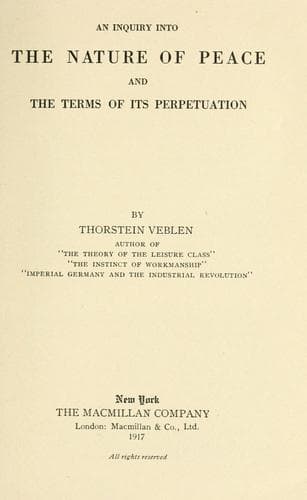
An Inquiry into the Nature of Peace and the Terms of Its PerpetuationVeblen, Thorstein
Philosophy
An Inquiry into the Nature of Peace and the Terms of Its Perpetuation
Veblen, Thorstein
Peace; World War, 1914-1918 -- Peace
The current, and still more this prospective, case of the
quasi-self-directing middle class may fairly be illustrated by the case
of the American farmers, of the past and present. The American farmer
rejoices to be called "The Independent Farmer." He once was independent,
in a meager and toil-worn fashion, in the days before the price-system
had brought him and all his works into the compass of the market; but
that was some time ago. He now works for the market, ordinarily at
something like what is called a "living wage," provided he has
"independent means" enough to enable him by steady application to earn a
living wage; and of course, the market being controlled by the paramount
investment interests in the background, his work, in effect, inures to
their benefit; except so much as it may seem necessary to allow him as
incentive to go on. Also of course, these paramount investment interests
are in turn controlled in all their manoeuvres by the impersonal
exigencies of the price-system, which permits no vagaries in violation
of the rule that all traffic must show a balance of profit in terms of
price.
The Independent Farmer still continues to believe that in some occult
sense he still is independent in what he will do and what not; or
perhaps rather that he can by shrewd management retain or regain a
tolerable measure of such independence, after the fashion of what is
held to have been the posture of affairs in the days before the coming
of corporation finance; or at least he believes that he ought to have,
or to regain or reclaim, some appreciable measure of such independence;
which ought then, by help of the "independent means" which he still
treasures, to procure him an honest and assured livelihood in return for
an honest year's work. Latterly he, that is the common run of the
farmers, has been taking note of the fact that he is, as he apprehends
it, at a disadvantage in the market; and he is now taking recourse to
concerted action for the purpose of what might be called "rigging the
market" to his own advantage. In this he overlooks the impregnable
position which the party of the second part, the great investment
interests, occupy; in fact, he is counting without his host. Hitherto he
has not been convinced of his own helplessness. And with a fine fancy he
still imagines that his own interest is on the side of the propertied
and privileged classes; so that the farmer constituency is the chief
pillar of conservative law and order, particularly in all that touches
the inviolable rights of property and at every juncture where a division
comes on between those who live by investment and those who live by
work. In pecuniary effect, the ordinary American farmer, who legally
owns a moderate farm of the common sort, belongs among those who work
for a livelihood; such a livelihood as the investment interests find it
worth while to allow him under the rule of what the traffic will bear;
Public-domain text, read in full here on John Shaqi.
Reviews
Reviews
No reviews yet
Be the first to share your thoughts on this work.
Elsewhere in the archive
Join the Discussion
Join the discussion
Sign in to leave a comment or review.
Sign InorCreate an account